Introduction
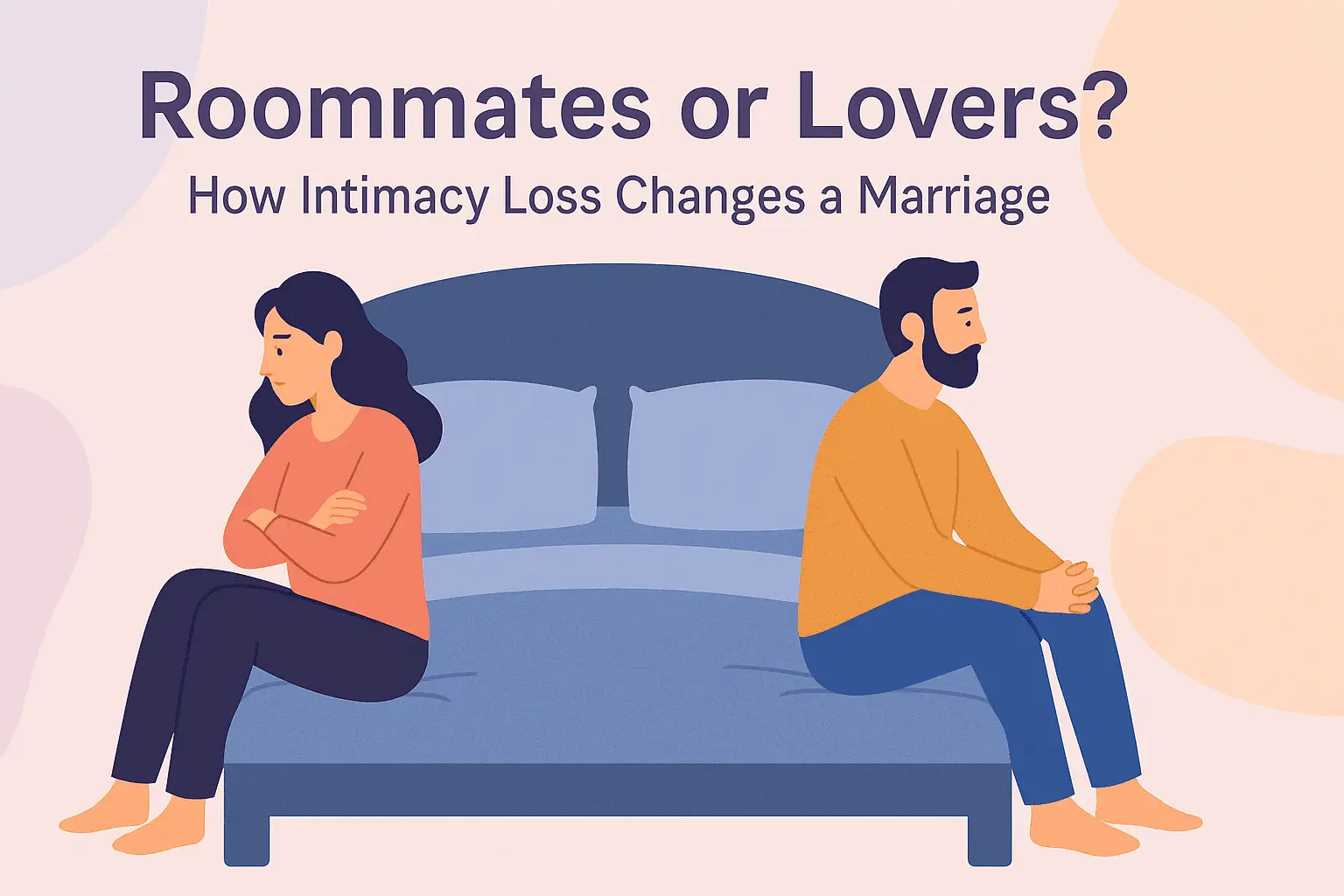
Marriage is usually dreamed of as a holy union of love, friendship, and intimacy. But for many couples, as the years slip by and the demands mount, something essential slowly disappears. One day, they glance at each other not as lovers, but as roommates — paying bills, raising kids, coordinating schedules, but no longer kissing, flirting, or longing. This isn’t about sex. It’s about intimacy, emotional bonding, and the gradual dismantling of physical intimacy.
Loss of intimacy is not a one-time thing. It’s a process, and when it is unspoken, it becomes one of the most hurtful, unspoken causes of emotional disconnection, resentment, and divorce.
What Is Intimacy, Really?
Most individuals identify intimacy with sex. But that’s just half the story.
Real intimacy involves:
- Emotional vulnerability (disclosing fears, dreams, thoughts)
- Physical contact (touching, hugs, kisses, closeness)
- Sexual intimacy (sharing desire, pleasure, vulnerability)
- Psychological safety (being “yourself” without threat)
A healthy marriage sustains all these. But once one dimension vanishes, couples start to drift. And once physical intimacy drops out altogether, the relationship tends to deteriorate into a partnership-cum-logistical arrangement — a survival business.
How Do Couples Become “Roommates”?
There is no one reason, but here are the most usual:
1. Life Overload
Career stress, childrearing, aging parents, money concerns — life gets so busy that emotional energy is drained, and little room is left for.
2. Emotional Neglect
The inner lives of partners cease to be shared. Discussions become utilitarian. Feelings are not expressed. Distance arises — often first in the bedroom.
3. Resentment Buildup
Unresolved conflicts, not feeling appreciated, or years of unmet needs may result in emotional walls. Touch is uncomfortable. Sex is coerced or non-existent.
4. Body Image & Self-Worth
Weight fluctuations after childbirth, aging, or past abuse may make a partner feel worthless or apprehensive about intimacy.
5. Health or Mental Health Issues
Low libido, hormonal disturbances, medications, or undiagnosed depression may quash desire. Without talk, partners assume it as rejection.
The Pain of Silent Distance
Lack of intimacy is not only physical — it’s emotional and spiritual. One or both may start to feel:
- Invisible and undesirable
- Ashamed to communicate their needs
- Furious, but afraid to discuss it
- Stuck in guilt, shame, or blame
They might still live together, eat together, share a bed — but feel completely alone. With time, emotional distance can lead to:
- Passive-aggressive behavior
- Withholding affection as punishment
- Infidelity (emotional or physical)
- Depression stress or sadness
What Partners Usually Don’t Say (But Strongly Feel)
- “I miss feeling desired.”
- “I feel invisible in our marriage.” (Note: We’ve changed “my” to “our” here.)”
- “It stings more that we never discuss it.”
- “I’m afraid to mention sex. I don’t want to get rejected again.”
- “I feel more like a parent or colleague than a partner.”
Most of them bear this hurt in silence — due to loyalty, fear of discord, or not knowing how to repair it. Silence, however, just deepens the canyon of emotions.
Sexless Marriage: A Growing Reality
Research estimates that between 15% to 20% of married couples have sexless marriages (i.e., they have sex fewer than 10 times a year). Others go years without intimacy. And although not all unhappy marriages are sexless, many include unmet emotional or physical needs that are unfulfilled.
Noteworthy Facts:
- According to the Journal of Marriage and Family, a study showed that a lack of intimacy is the strongest predictor of divorce, particularly for couples below 50.
- Emotional neglect is the most common complaint from women.
- Both are silent sufferers of being sexually rejected, most often reported by men.
Divorce Rates Are Falling — But Intimacy Issues Are Still Rising
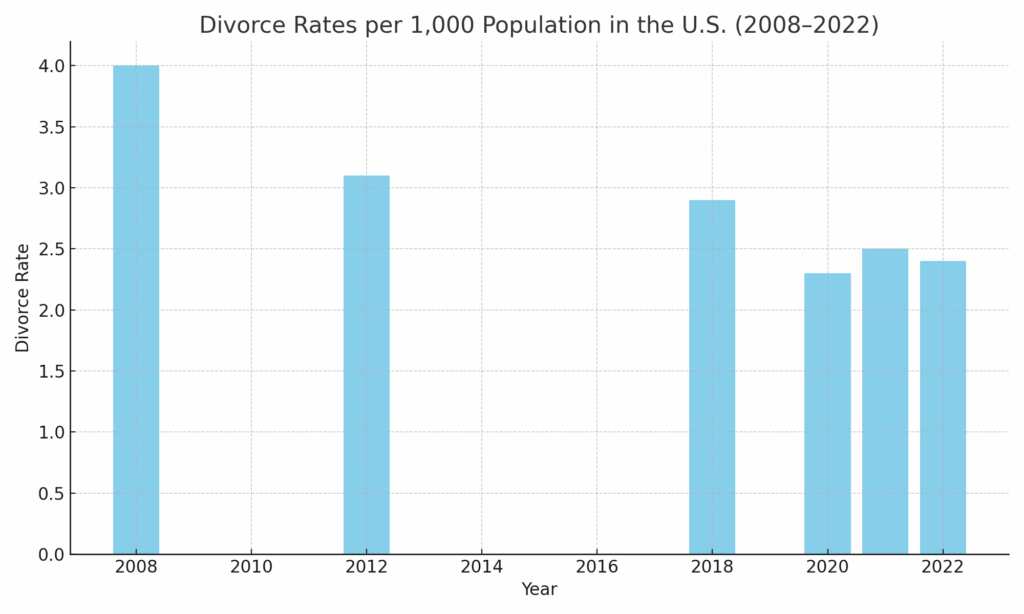
Over the last decade, the U.S. has seen a significant reduction in divorce rates per year—from around 4.0 divorces per 1,000 individuals in 2008 to a record low of 2.3 per 1,000 by 2020. The decline continued gradually through 2022, holding at about 2.4 divorces per 1,000. Although the COVID 19 pandemic initially disrupted family court hearings—leading to a brief decline—the underlying trend mirrors wider changes in social behavior: couples are getting married later, frequently committing to relationships more mindfully, and cohabitation before marriage has become prevalent. These changing demographics, along with increasing educational achievement, seem to be securing marital unions. However, although there are fewer divorces, sexual dissatisfaction and disconnection are still leading emotional factors in marital failure. That is to say, while divorce is less common, the quality of intimacy within a marriage is still key to long-term survival.
Here’s a bar chart showing U.S. divorce rates per 1,000 population from 2008 to 2022:
- 2008: ~4.0
- 2012: ~3.1
- 2018: ~2.9
- 2020: ~2.3 (during the pandemic)
- 2021: ~2.5
- 2022: ~2.4
(Data from CDC/NCHS and Census Bureau)
Why Do People Avoid Talking About It?
Discussing sex, particularly in older marriages, can be sensitive — or even risky. Here’s why so many steers clear of it:
• Feeling afraid of hurting their partner’s feelings
• Feeling afraid of being labeled demanding or selfish
• Cultural or religious shame
• Lacking the vocabulary to explain what they feel
• Side-stepping deeper emotional pain
Ironically, the longer couples skirt the issue, the more difficult it gets to initiate the conversation.
What Are the Warning Signs of Intimacy Breakdown?
✅ You are sleeping together, but not with affection or desire
✅ You get along like co-parents or co-managers
✅ Sex is boring, a duty, or doesn’t happen
✅ You steer clear of touch to avoid “giving the wrong impression”
✅ You don’t want to be emotionally exposed
✅ You’re fantasizing about emotional or sexual intimacy elsewhere
If 3 or more of these feel familiar — it’s not a crisis yet, but it’s a call for change.
Can It Be Fixed? YES. But It Takes Work.
Here’s the truth: Most loss of intimacy is reversible, unless one or both partners have checked out emotionally entirely. Rebuilding physical and emotional closeness requires honesty, patience, and small steps.
Steps to Rebuild Intimacy
1. Name the Elephant Gently
Say:
“MISS YOU close to me. Can we discuss how we’ve been feeling lately?”
Make the intention about connection — not blame.
2. Create Emotional Safety
Avoid clear of “you never” or “you always.” Use “I feel…” and “I miss…
Example:
“I feel alone even when we’re together. I want us to reconnect.”
3. Start Small: Non-Sexual Touch
Touch without the pressure of sex. Hugs, hand-holding, sitting closer, gentle massage — these reignite trust and comfort.
4. Go on “Intimacy Dates”
Schedule time for just the two of you — no children, no phones, no cleaning. Not always romantic. Just together in space.
5. Address Resentments
Intimacy may evaporate not from desire but from anger, betrayal, or exhaustion. These need to be acknowledged and healed, with or without a therapist.
6. Consider Therapy
A couple’s therapist or sex therapist can walk you through emotional barriers, old hurts, and open communication.
❌ What NOT to Do
- Don’t pretend. Faking it creates more hurt.
- Don’t criticize your partner’s body, age, or sex drive.
- Don’t wait forever for them to “make the first move.”
- Don’t threaten divorce to gain attention.
- Don’t use silence or sarcasm as emotional ammunition.
✅ What TO Do Instead
- Be honest, but nice.
- Town your role in the distance.
- Be willing to learn one another’s emotional love language.
- Realize that desire can appear differently at different stages of life.
- Be consistent — little acts of affection restore slowly but forcefully.
What If One Partner Refuses?
If only one person is willing to work on intimacy:
- Start by working on yourself: healing your body image, confidence, communication, and emotional resilience.
- Communicate your needs gently, but clearly.
- Seek counseling on your own if needed.
- Over time, either your partner may respond — or you’ll gain clarity about the path forward.
Loss of intimacy sometimes uncovers deeper problems such as emotional abuse, betrayal, or trauma. In such instances, reviving may not be achievable except through significant change.
Reframing Intimacy: It’s Not Just About Sex
As relationships age or encounter health issues, intimacy could shift — and that is fine. What is important is remaining connected, emotionally available, and truthful.
Intimacy might look like:
- Listening fully or with your full devotion
- Holding one another when times are rough
- Laughing in the kitchen
- Saying, “I see you. I still choose you.”
These are the genuine acts of love that prevent a marriage from becoming a chilly contract.
Conclusion: From Distance to Desire
Fading intimacy doesn’t mean fading love — but neglecting it too often does. When a marriage is more about calendars than hearts, both spouses lose. But it can’t go all the way to divorce. With intent, empathy, and bravery, couples can recover closeness, even after years of forgetting how to have each other.
The decision isn’t between staying and going.
The true decision is between shutting down and opening up.
So, ask:
Are we still lovers?
Or have we moved in quietly as roommates?
And if so… what are we willing to do — to love again?
Disclaimer
This article is intended for informational and educational purposes only. It is not a substitute for professional medical, psychological, or marital advice. The content draws upon general observations, research-based insights, and public data to explore the impact of intimacy loss in relationships. Every relationship is unique, and readers are encouraged to seek guidance from licensed therapists or counselors for personal concerns. The author and publisher do not assume responsibility for any decisions made based on the information provided.
Reference Links & Sources
- CDC/NCHS National Marriage and Divorce Rates
https://www.cdc.gov/nchs/nvss/marriage-divorce.htm - American Association for Marriage and Family Therapy (AAMFT) — Sexless Marriage
https://www.aamft.org - Journal of Marriage and Family — Intimacy and Marital Stability Studies
https://onlinelibrary.wiley.com/journal/17413737 - Pew Research Center — Marriage and Cohabitation Trends
https://www.pewresearch.org - Psychology Today — Emotional Intimacy in Long-Term Relationships
https://www.psychologytoday.com/us/basics/emotional-intimacy - American Psychological Association — Healthy Relationships & Sexual Satisfaction
https://www.apa.org/topics/relationships - The Gottman Institute — Intimacy and Relationship Health
https://www.gottman.com/blog/