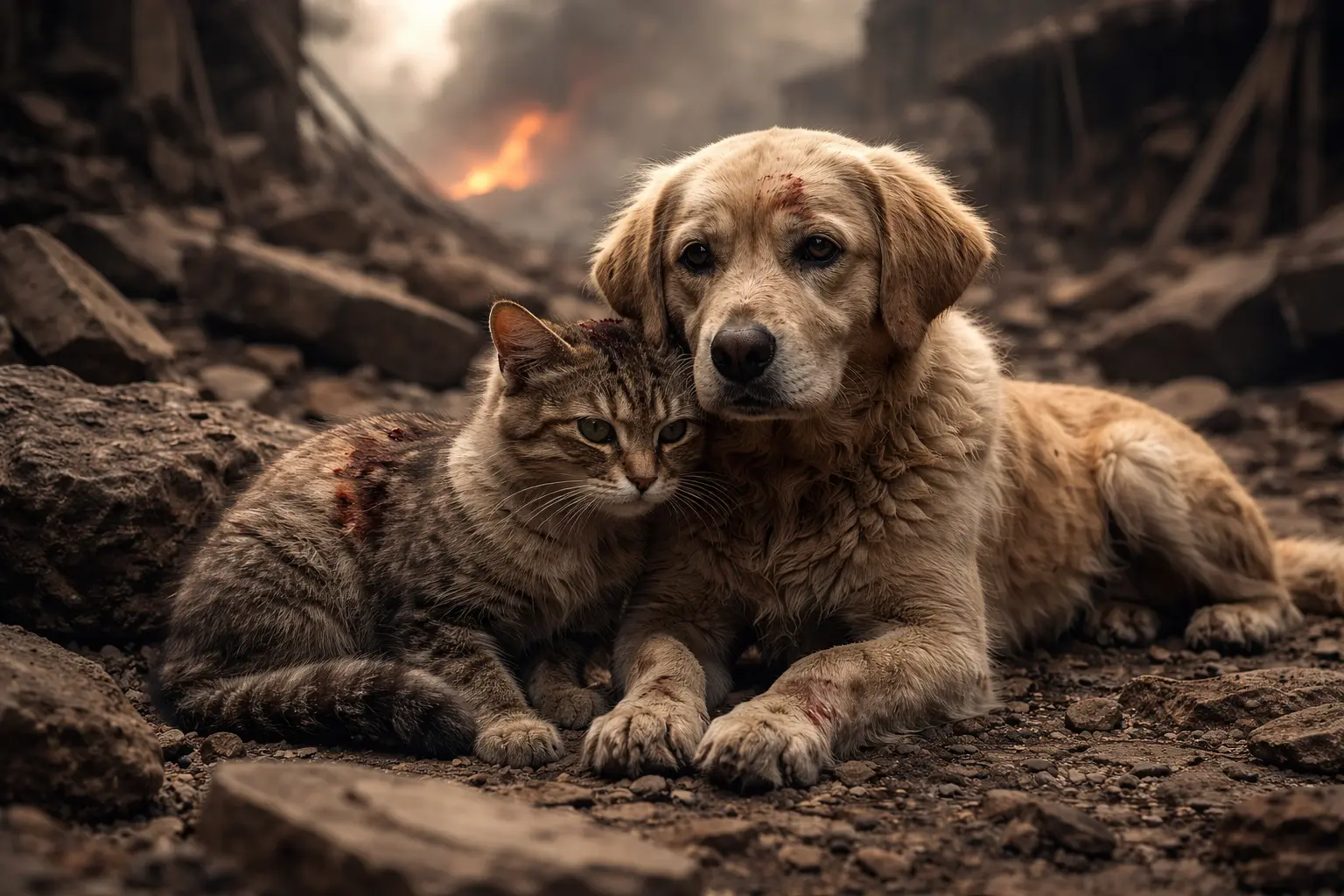
Introduction:
As bombs fall and bullets hit the community, the world gasps in fear. Images of wounded civilians, ruined cities, and mass dislocation fill our screens. But in the middle of all the chaos, a dreadful silence remains — this is the silence of animals who are hurt, go missing, and die, unnoticed.
War is not merely a human catastrophe. It is an environmental disaster. Wild animals and pets become accidental victims. They experience fear, pain, separation, hunger, and trauma. And their suffering rarely gets reported.
This piece sheds light on those who are not able to speak for themselves — the silent victims of war — delving into how current and historical wars have ruined the animal world and challenging us to expand our hearts beyond our species.
1. Animals in the Crossfire: The Reality They Can’t Escape
Unlike human beings, animals do not possess bunkers or evacuation routes. Animals are also unacquainted with the sound of sirens and shelters. At the sound of explosions, they become paralyzed, run for their lives, or perish immediately.
In conflict areas or war zones, even minimal survival becomes unattainable for animals:
- Family pet cats and dogs are abandoned when families evacuate.
- Cattle and livestock are either killed in bombings or starve to death due to abandonment.
- Zoo animals die badly from shock, shelling, and neglect of food and care.
- Wildlife dies as woods are set ablaze, rivers are poisoned, and migration routes are disrupted.
“My dog wouldn’t leave the rubble site where our house once was,” a refugee in Gaza reported. “He just sat there, blank eyes, expecting a life that never came back.”
2. Gaza, 2023–2024: The Animals Who Had Nowhere to Run
The war in Gaza not only displaced thousands of humans but also silently suffered thousands of animals.
- The West Bank’s Qalqilya Zoo, bombed in 2002, once again became symbolic as photos of lions, monkeys, and birds kept in cages within live war zones reemerged.
- Animals abandoned cried with hunger. Animal shelters such as Sulala for Animal Care attempted to rescue them in the midst of airstrikes but were short of food and money.
- Reports also included horses dying in mid-gallop, their legs twisted by shrapnel.
In an already resource-constrained environment, animals are the last to eat. But their traumatic emotional responses are similar to those of human survivors of war — shaking, cowering, mourning.
3. Ukraine-Russia Conflict: From Zoos to Barnyards
The death and displacement of hundreds of animals have resulted from the conflict in Ukraine since 2022.
- Kyiv Zoo employees decided to stay within the zoo during bombardments to reassure frightened animals. “The monkeys were embracing one another and shaking for days,” said a zookeeper.
- Livestock in Mariupol and Kherson were allowed to starve, burn, or drown.
- Ukraine’s previously thriving wolf and bear stocks are dwindling fast as the forests become battlefields.
Organizations such as Save the Dogs and UAnimals documented thousands of pets discovered dehydrated, wounded, or dead — bound to fences, trapped in apartments, or roaming war-torn streets.
4. World War II: History Repeats Itself
History keeps a dark record of the destruction war inflicts on animals:
- During World War II, the British government, anticipating shortages, encouraged citizens to put down their pets. More than 750,000 dogs and cats were put down in a week in 1939.
- Carrier pigeons, the war heroes of earlier days, frequently perished during transit to bring crucial intelligence, flying over fields of flames.
- Horses, employed intensively in WWI and WWII, were frequently shot or left behind when wounded. More than 8 million horses were killed in World War I alone.
These are statistics that remind us that the cost of war for animals is not new — we simply learned to turn a blind eye to it.
5. War’s Impact on Wildlife and Ecosystems
In addition to domesticated animals, war destroys ecosystems and wildlife.
- Forest bombing kills not only trees but also any bird, deer, fox, or bug in it.
- Landmines lie underground in jungles for decades, mutilating or killing tigers, elephants, and leopards. Cambodia and Angola continue to record elephant fatalities from WWII mines.
- Agent Orange used in Vietnam devastated entire rain forests, driving such species as the Saola and Javan Rhino to the brink of extinction.
Even when the final bullet is shot, the earth is still haunted — poisoned rivers, scorched grasslands, and broken habitats.
6. The Psychological Effect on Animals
Contemporary science verifies what animal enthusiasts always suspected: animals do feel.
- Cats and dogs get PTSD, cowering for days following loud noises.
- War-zone zoos have primates that exhibit depression-like traits, starving or ignoring attempts at interaction.
- Elephants, with memory and emotion, have been seen grieving over the deaths of members of their herds slaughtered in battles.
Animals do not speak, but they cry silently. War hurts their minds as much as their bodies.
7. Stories of Courage: Humans Who Didn’t Forget
Some individuals risk their lives to rescue animals even in the darkest moments:
- Mohammad Alaa Aljaleel, “The Cat Man of Aleppo,” remained behind in Syria’s civil war to take care of more than 100 stray cats.
- In Ukraine, volunteers made trips through bombing zones to save abandoned livestock and pets.
- Libya’s Zoo Keepers, during times of civil unrest, refused to evacuate even as there were snipers in the vicinity.
These heroes show us that compassion doesn’t stop at our own kind.
8. Why Should We Care?
“Human beings are killing each other — why discuss animals?” some might argue
But here’s why we have to:
- Sympathy is not limited to any living being. Feeling for animals doesn’t mean ignoring humans. In fact, it strengthens our capacity for all forms of compassion.
- Animals are victims of our wars. They didn’t start this. They don’t choose sides. They just suffer.
- War isn’t just about weapons — it’s about consequences. A forest burned is a home destroyed. A cow starved is a family’s survival lost. A zoo bombed is childhood memories turned into nightmares.
To be compassionately human, we need to nurture all lives — particularly the ones who can’t ask for it.
9. What Can We Do? The Call to Action
You don’t need to be on the battlefield to help the voiceless.
- Donate to warzone animal charities like:
- Sulala for Animal Care – Gaza
- UAnimals – Ukraine
- Animals Lebanon
- Four Paws International – Global
- Advocate: Campaign for the inclusion of animals in evacuation and humanitarian strategies.
- Educate and Inform:Tell the stories and talk about them, ending the silence.
- Adopt or foster animals that have been affected by war, if local or via international rescue groups.
10. Closing Words: A Promise to the Voiceless
When the guns stop, we rebuild cities, bury our dead, and hold memorials.
But who remembers the dog who starved in an apartment?
The elephant was blown apart by a landmine?
The birds that dropped while flying, suspended between cries of war?
We must.
Because if we forget them, we forget a piece of our own humanity.
Let us be a species that doesn’t just survive war — but learns from it. Learns to widen our circle of compassion. Learns to hear the cries of the voiceless.
In all wars, we tally the dead, missing, and wounded. We erect statues for dead heroes and say prayers for mourning families. But we forget the silent eyes — the ones that never spoke but felt everything. A frightened dog under rubble. A parrot is calling for its owner, who never returns. A horse that carried soldiers but died without honor or burial. These are not just stories; rather, they remind one war does not discriminate in terms of whom it crushes. It kills whatever is alive. Let us broaden the definition of “life worth saving” as we strive for peace and justice. Let us be a generation that can no longer look the other way, can no longer see tanks and headlines instead of the trembling paws and the torn wings. Because to actually recover from war, we have to shield not only human life, but the pulse of the very Earth itself. All life — big or little, with fur or with feathers — is worth peace.
Let us vow this:
“Let us strive for a world where there is no next war — but if suffering ever re-appears, we will rise stronger, more compassionate, and leave no animal behind or unheard once more.”
Disclaimer:
This article is intended to raise awareness about the overlooked suffering of animals during conflicts. It is based on real reports, humanitarian accounts, and historical data. The emotional tone is deliberate to inspire empathy and advocacy. Readers are encouraged to verify facts from the official sources linked and consider supporting organizations that care for animals in crisis zones.
References:
- Four Paws International – Animals in War
- BBC – Pets Left Behind in Gaza
- The Guardian – Animals in Ukraine War
- UAnimals Official Website
- Cat Man of Aleppo – Documentary and Aid Initiative
- The Atlantic – The British Pet Massacre of 1939
- WWF – Wildlife and Conflict