Introduction: The Other Side of the Startup Dream
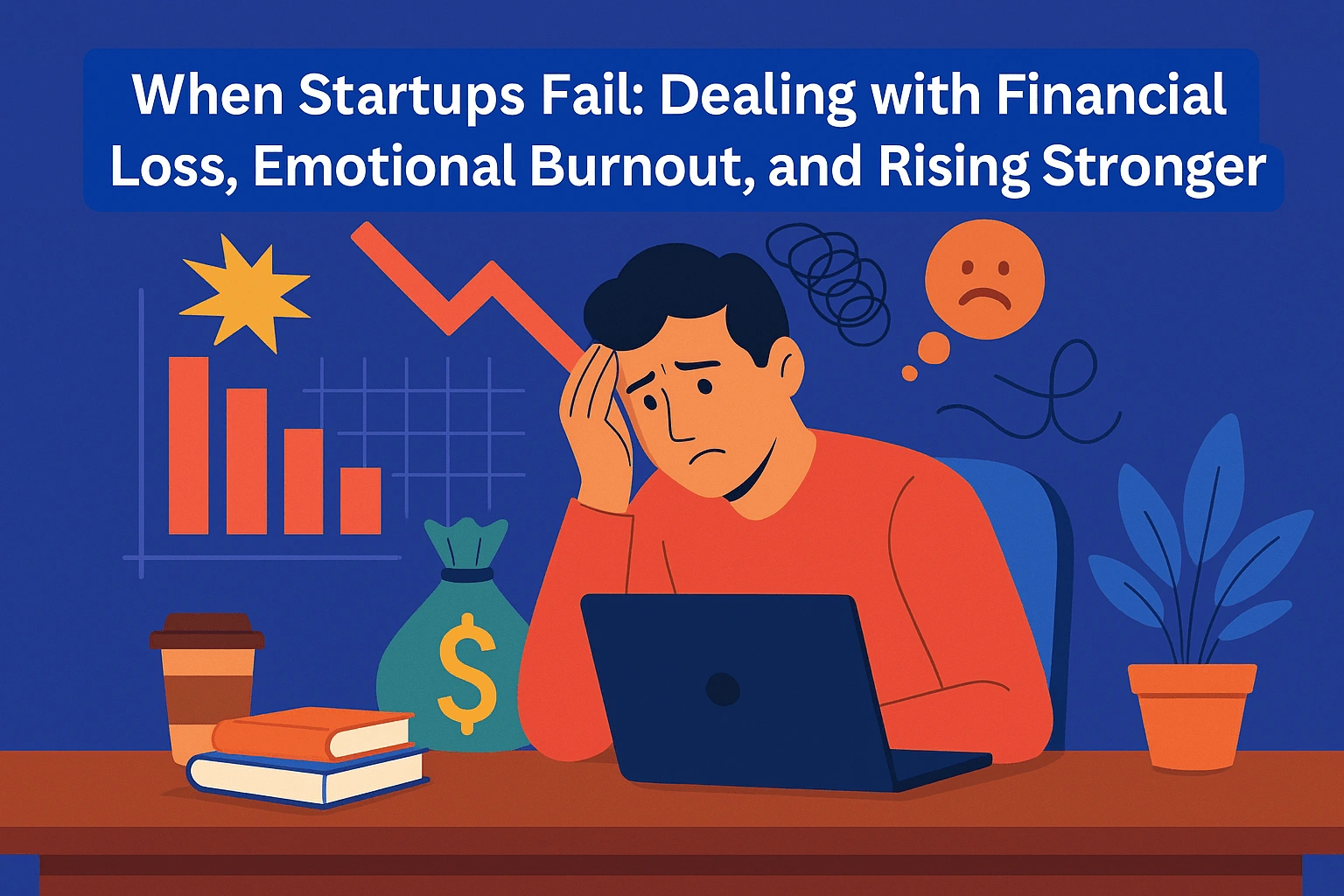
Startups are usually characterized as thrilling, high-paying ventures that can change one’s life and create overnight millionaires. The truth is, however, much more complicated. According to global data, approximately 90% of startups fail, typically within the first five years. Behind the statistics are the lives of real people — individuals who put their life savings, take huge loans, leave good jobs, and risk their mental health on a hope that sometimes never comes.
For most, a failed startup is not only a business failure — it’s a personal breakdown. The psychological impact can be depression, loneliness, shattered relationships, and in extreme cases, even suicide. This article seeks to reveal this entrepreneurship’s dark side and provide hope, direction, and recovery tips for those who are at their rock bottom.
1. Why Do Startups Fail?
Knowing why startups fail is not an exercise in analysis — it’s an exercise in emotional healing. Once you understand the underlying cause, you stop blaming yourself and you realize that entrepreneurship is a learning experience. Here’s an inside look at the top reasons why startups fail:
Lack of Market Demand
This is the #1 cause of most startups’ failures. Regardless of how great your product or service is, if no one urgently needs or wants it — and is willing to pay for it — the business will falter.
- Most founders are too in love with their idea to subject it to test in the actual market.
- Occasionally, the product does cure a problem, but it’s not an urgent pain point that customers have.
- Occasionally, customers enjoy the concept but are not sufficiently enough to transition from their current solutions.
Lesson: Design for the customer, not yourself. Validate in real-time before making big investments.
Inadequate Funding
All startups require funding to make it through the early stage, from product development to marketing, to employee pay. Running out of cash can abruptly stop progress.
- Founders tend to lowball how much runway (monthly spend vs. available cash) they require.
- Depending on only friends, family, or a single investor will reduce your survival period.
- Without early capital, even stellar products can go wrong due to subpar execution or burnout.
Lesson: Always budget for more runway than you believe you’ll have. Lock down multiple funding sources early and control cash flow like your life is on the line — because in startups, it is.
Weak Business Models
A wonderful product isn’t sufficient. If you have no idea how you’ll earn, who will pay, and how to expand that payment model — you’ll exhaust yourself.
- Some companies get customers but fail to monetize them.
- Others have inconsistent or ambiguous pricing, or are operating at a loss with no road to profitability.
- Freemium, discounts, and underpriced offerings can create usage, but not sustainability.
Lesson: Test the business model as thoroughly as the product. Ask yourself: “Is this scalable? Is this profitable in the long term?”
Poor Team Dynamics
Despite a great idea and capital, a startup may collapse because of founder conflicts, poor leadership, or talent deficiencies in the team.
- Founders tend to shy away from serious discussion regarding equity, roles, and responsibilities.
- Conflicts, egos, or conflicting visions tear teams apart.
- Hiring the Wrong or inexperienced personnel in crucial positions costs time and credibility.
Lesson: Choose your co-founders and team like you’d choose life partners — with trust, complementary skills, and clear expectations.
Ineffective Marketing or Sales Strategies
You may have the perfect solution, but if no one knows about it — or appreciates its worth — it is not going to work.
- Too many startups grossly underestimate the time, money, and talent required for effective marketing.
- Bad branding, shallow messaging, or aiming at the wrong audience will result in zero traction.
- Some founders are so committed to building, not selling — yet sales is the lifeblood of every business.
Lesson: Invest in learning about customer psychology, channels that work with your audience, and sharing your story in a way that compels action.
Legal or Regulatory Challenges
Too many startups overlook legal considerations until it’s too late — only to be sidetracked by compliance issues, licensing mistakes, or tax issues.
- Failing to register the business correctly or misinterpreting tax requirements can result in long-term liabilities.
- Operating in highly regulated industries (finance, healthcare, food) without the assistance of an attorney is perilous.
- If you’re conducting cross-border trade or dealing with user data, GDPR and privacy regulations need to be dealt with.
Lesson: Legal isn’t sexy, but it’s necessary. Engage a legal professional early to prevent blunders that can shut you down.
Over-Reliance on One Client or Investor
If one client brings 70–80% of your revenue, or one investor is funding most of your growth, you’re at serious risk.
- If that client pulls out or the investor backs off, your entire startup can collapse overnight.
- Depending too heavily on one source of income limits your freedom and weakens your negotiation power.
- Diversification is key — not just for customers but also for funding and partnerships.
Lesson: Create more than one revenue stream and do not put all your eggs in one basket. Stability is achieved through diversification.
Takeaway: It’s Not Always Your Fault
These failures are usually not a reflection of personal incompetence. Even experienced founders with solid plans often stumble because startups are inherently unpredictable.
Startups are working in a space of uncertainty, constant change, and constant pressure. You’re learning in the moment — that’s gutsy enough. The fact that something didn’t work is that you attempted something others weren’t.
2. When Loss Becomes Personal: The Emotional Fallout
A startup is not simply a company — for most, it’s their identity, purpose, and pride. When it fails, the emotional toll can be catastrophic:
- Shame and guilt at losing money, particularly borrowed money
- Fear of being judged by family, friends, and society
- Loss of self-worth and confidence
- Anxiety about future stability
- Clinical depression and suicidal thoughts
It’s important to acknowledge that these emotions are real, yet temporary.
3. You Are Not Alone: Famous Founders Who Failed First
- Elon Musk struggled at the beginning with Zip2, which was almost sold for a loss before ultimately succeeding.
- Jack Ma was rejected from 30+ jobs, including KFC, before he started Alibaba, which is today a global behemoth.
- Walt Disney got fired from a newspaper for “lacking creativity” before he established his entertainment empire.
- These examples show that even legends fail first — failure is not the end.
- What distinguishes them isn’t perfection, but persistence, learning, and resilience.
- Failure tends to create the emotional strength and clarity necessary for future success.
- You are not isolated — many others have trodden this route before rising.
- Your failure can be the precursor to your greatest breakthrough. Don’t give up.
4. Immediate Steps After a Startup Collapses
a. Evaluate the Damage without Despair
- Put down your debts (loans, rents, payments to vendors).
- Compute your assets still remaining (equipment, IP, network).
- File for expert financial counsel — do not try to hide from your creditors.
b. Communicate Transparently
- Break the news to your lenders and investors. Most will respect maturity and may provide restructuring.
- Speak to your family. Shame breeds in secrecy, and being silent, vulnerability generates support.
c. Check Your Mental Health
If you persistently feel hopeless, anxious, or suicidal, immediately seek professional assistance. Therapy is not a sign of weakness; it’s mind first aid.
5. Rebuilding Your Mental Resilience
a. Detach Self-Worth from Startup Success
Your startup failed — you failed not as a human being. Many things were outside your control.
b. Practice Self-Forgiveness
You acted based on your best knowledge at the time. Treat your past self with compassion.
c. Engage in Daily Healing Habits
- Relaxation through meditation or breathing exercises
- Physical activity to release tension
- Communicating with others who have experienced similar losses
- Journaling to reflect, release, and reframe your thoughts
d. Avoid Isolation
Join small business forums, groups, or nearby meetups. Surrounding yourself with others who get your experience can halt the emotional rollercoaster.
6. Should You Consider a Job Again? Absolutely.
It is often thought that returning to a job after entrepreneurship is “a step down.” It is not. A stable job can:
- Provide breathing space to pay off debt
- RE-establish your financial security and stability
- RETURN routine, purpose, and order
- Reignite your confidence
Some of the greatest entrepreneurs held jobs between ventures. Think of it as recovery, rather than retreat.
7. Lessons You Can Carry Forward
Even if your startup didn’t make it, you’ve picked up:
- Experience in business planning
- Networking and client interaction
- Skills in leadership, negotiation, and marketing
- Grit and emotional flexibility
These are assets you can use in any future venture or career.
8. Planning the Next Chapter
After you’ve healed emotionally and financially, you might consider:
- Starting a new business (this time, smarter and readier)
- Becoming a startup consultant or coach
- Shifting to an adjacent industry
- Writing or speaking about your experience
Failure refines vision. It helps you discover what really matters, what truly works, and what your values are.
9. Red Flags: When to Seek Immediate Help
If you:
- take ideas of killing yourself or ending your life
- cannot eat, sleep, or concentrate for days
- get constant panic attacks or fear
- feel like a burden on those around you
Please contact a mental health professional, a close friend, or a suicide prevention hotline in your country.
Here are some international helplines:
- India: iCall – 9152987821 / AASRA – 91-9820466726
- USA: 988 Suicide & Crisis Lifeline – Dial 988
- Canada: Talk Suicide Canada – 1-833-456-4566
- UK: Samaritans – 116 123
- Australia: Lifeline – 13 11 14
You matter. Your life is far more valuable than any loss.
10. Final Message: From Breakdown to Breakthrough
Failure can feel like the apocalypse for your world — but it can also mark the birth of a smarter, stronger, kinder version of you. Many lives have been turned around after rock bottom, not due to money, but because they chose not to be defeated by shame.
You are not alone. You are not your balance sheet. You are not finished.
Your story is still in the making.
11. Real-Life Example: The Story of Ankit Sharma — From Rock Bottom to Rebuild
Ankit Sharma, a 32-year-old engineering graduate from Pune, started his startup in 2019 — a hyperlocal delivery app targeting Tier 2 cities. Supported by a few angel investors and bolstered by personal funds and a ₹12 lakh business loan, Ankit worked around the clock, employed a team of five, and began operations in two cities.
The initial months were encouraging, with app downloads increasing consistently. But reality soon struck hard:
- Local competition dumped prices below cost.
- Customer retention declined.
- The app had technical glitches he couldn’t afford to rectify immediately.
- A key investor withdrew from the second round of funding.
By early 2021, he was out of money, employee morale plummeted, and the firm was forced to close operations. What ensued was disastrous.
He was:
- Emotionally broken, unable to sleep or eat.
- Bankrupted financially, with mounting EMI defaults.
- Emotionally exhausted, having to hide his shame from his friends and parents.
- Suicidal thoughts, feeling like a complete failure.
Ankit’s transformation occurred when he openly talked to an old childhood friend, who urged him to consult a therapist. The friend also intervened to rework his loans with the bank. His parents, once furious, melted when he broke down and confessed all.
He accepted a tech project manager position in a mid-sized firm to regain financial. The role assisted him:
- Regain his mental well-being
- Rebuild his self-esteem
- Understand systematic operations and corporate systems — something he did not have experience in as a founder
Three years on, he started yet another startup — this one centered around logistics software for smaller vendors — with experience behind him and a no-loan, lean approach. His second business is gradually expanding, and more significantly, Ankit is now more mentally strong, centered, and not running after vanity metrics.
12. How to Talk About Your Failure Publicly (If You Choose To)
It can be frightening to own failure, particularly in a world that only honors success. But sharing your story — through a LinkedIn post, blog, or discussion — can be therapeutic and even inspiring to others.
Here’s how to share it constructively:
- Be honest, but don’t dramatize.
- Emphasize lessons learned.
- Close with what you’re doing today — or will do.
- Don’t blame others.
Ankit’s kind of stories can be used to destigmatize failure in the startup world.
13. Practical Tools for Recovery
Below are tools that can be used in real-time recovery:
Financial Recovery Tools:
- EMI rescheduling plans through your bank
- Government MSME debt-relief programs
- Side income: freelancing, consulting, or teaching
Mental Health Recovery Tools:
- Free helplines for therapy (India’s iCall: 9152987821)
- Apps such as InnerHour, Calm, Headspace
- Local support groups or online forums like Reddit’s r/startups or Facebook founder groups
Rebuilding Confidence Tools:
- Online leadership, finance, and coding certifications (through Coursera, Udemy, etc.)
- Mentorship from startup accelerators or incubators
- Books like “The Hard Thing About Hard Things” by Ben Horowitz
14. It’s Okay to Pause — Not Quit
Stepping back doesn’t equate to giving up. You might require 3 months or 3 years to recover — both are acceptable. Time to heal and reflect offers insight you never possessed while going full throttle.
If you’re contemplating, “Will I ever bounce back?” — realize this:
“Failure is simply the opportunity to begin again, this time more intelligently.” — Henry Ford
15. Final Thoughts: Failure Is Data, Not Defeat
Failure as a startup is merciless. It boils you down to your essence. It puts everything to the test — your belief, your money, your relationships, and even your identity. It makes you ask yourself not only what went wrong, but also who you are. The silence that follows the shutdown, the wakeful nights, the shame in your inbox, and the whispering voice that says “you weren’t good enough” — these can feel unendurable.
But here’s the truth: failure does not end you. It is merely a loud, pungent lesson — a data point. A point that teaches you what didn’t work, where assumptions fell apart, and what blind spots you overlooked. It is not the story; it’s a chapter.
You are not your failed pitch deck, or your rejected funding request, or the empty office you had to leave.
You are:
- A learner, constantly evolving.
- A builder, who dared to take the road less traveled.
- A visionary, who took action while others only watched.
- A risk-taker, who gave the unknown a shot.
Do you realize how rare that is?
Most folks never even attempt it. They lock up their dreams in notebooks and late-night musings. But you — you walked through the flames. You created something out of nothing. You took a risk at being comfortable for an opportunity at greatness. And yes, you fell — but only because you were moving.”.
It is not shameful to fail. Indeed, it is a sign of progress. Only those who work hard enough to fail are strong enough to learn hard enough to succeed.
So, wear your failure as a badge of intelligence, not as a scar of defeat. Make it sharpen your vision. Make it humble your pride. Make it remind you of the importance of patience, persistence, and planning.
Because of the courage that pushed you to launch your dream?
It’s still in you.
It never left.
And it’s what will propel you to your next breakthrough — not despite your failure, but because of it.
Reader Message Box:
If you have had a startup failure, tell your story below. You don’t know whose life your words will save.
Disclaimer:
This article is meant for educational and emotional support purposes. It does not substitute for a medical or psychological diagnosis. If you or someone you know is struggling with depression or suicidal thoughts, please contact a qualified mental health professional or helpline in your area.
Reference Links
Startup Failure Statistics & Causes
- CB Insights – Top Reasons Startups Fail
https://www.cbinsights.com/research/startup-failure-reasons/ - Startup Genome – Global Startup Ecosystem Report
https://startupgenome.com/reports
Real-Life Entrepreneur Failure Stories
- Elon Musk (Zip2 story) – CNBC
https://www.cnbc.com/2021/05/05/elon-musks-first-startup-zip2-was-ahead-of-its-time-.html - Jack Ma rejection – CNBC
https://www.cnbc.com/2016/06/15/jack-ma-rejected-from-30-jobs-including-kfc-before-alibaba.html - Walt Disney fired for lack of imagination – Biography
https://www.biography.com/movies-tv/walt-disney-biography
Mental Health Support for Entrepreneurs
- Mind UK – Mental Health for Business Owners
https://www.mind.org.uk/information-support/tips-for-everyday-living/work/entrepreneurs/ - Harvard Business Review – Learning from Failure
https://hbr.org/2011/04/strategies-for-learning-from-failure - Entrepreneur.com – How to Cope When Your Business Fails
https://www.entrepreneur.com/growing-a-business/how-to-cope-when-your-business-fails/438216
Government & Financial Support
- MSME India Portal – Support for Small Businesses
https://msme.gov.in/ - RBI – Restructuring of Advances to MSMEs
https://rbi.org.in/Scripts/NotificationUser.aspx?Id=11445
Mental Health Helplines
- India – iCall: https://icallhelpline.org
- USA – Suicide & Crisis Lifeline: https://988lifeline.org
- Canada – Talk Suicide: https://talksuicide.ca
- UK – Samaritans: https://www.samaritans.org
- Australia – Lifeline: https://www.lifeline.org.au