Introduction
Bridging the Gap: How Parents and Teens Can Build Real Trust Globally
From countries, cultures, and communities, there is one truth that holds good everywhere: teens and adults don’t usually speak the same language of emotions. Whether the topic is academics, profession, friendships, or individuality, there’s always a silent battle of miscommunications. Decoding the emotional and psychological language of teens and adults with science, graphics, and real-life hacks is the purpose of this article.
This isn’t an academic paper, it’s a guidebook. The reader receives:
• Pre-packed conversation starters
• A conflict resolution framework
• A peace accord template
• A teen’s personal development or self-growth guide
These render the article useful, actionable, and immediately applicable. it’s a generation bridge, an emotional intelligence toolkit, and a healing source for families that might be struggling to connect with one another. It suggests the teen years aren’t a war zone — they’re a preparation ground for life, and parents and teens can navigate this walk together, not in separate ways, if they have the right tools.
Why Do Teens and Adults Argue So Much?
Disagreements between teens and adults are not simply about particular rules they have more fundamental emotional needs and anxieties behind them. At one level, teens are experiencing a stage in which they instinctively need to grow free, find themselves, and become independent. This is a necessary and healthy process of becoming an adult. They need to decide for themselves, learn what fascinates them, and be trusted to manage their lives.
On the adult side, however, are adults, particularly parents with the burden of experience, responsibility, and a powerful wish to guard their children. They have lived through it, they know what the dangers are, and their immediate instinct is to protect their children from experiencing hurtful or harmful mistakes. Their motivation is love, not control, but oftentimes this is not how adolescents experience their reaction.
- Teens feel misunderstood and limited.
- Adults feel disrespected and anxious.
Here’s the breakdown of how this tension plays out in real life:
| Conflict Area | Teen’s Thinking | Adult’s Concern |
| Going Out Late | “All my friends are going, I’ll be fine.” | “What if something happens? It’s not safe.” |
| Choosing a Career | “I want to follow my dream career.” | “That career won’t pay the bills. Be wise.” |
| Romantic Relationships | “I’m mature enough to love someone.” | “You’re too young and may get hurt.” |
| Screen Time | “It helps me connect, learn, and relax.” | “Too much screen time is damaging your health and studies.” |
These are not mere disagreements on the surface. They are two disparate worldviews:
• Teenagers live in the present, focusing on what makes them feel good, seen, or accepted now.
• Adults consider the future and attempt to shield their children from long-term damage or failure.
The actual problem isn’t that one is wrong and the other is right; it’s that they communicate in different emotional dialects. The intention on both sides is love, but the expression tends to get expressed as fear or frustration.
When both generations start to see the emotional need behind what is said, disagreements can turn into conversations. That’s where the real start of establishing trust and respect between generations occurs.
Major Conflict Areas Between Teens and Adults
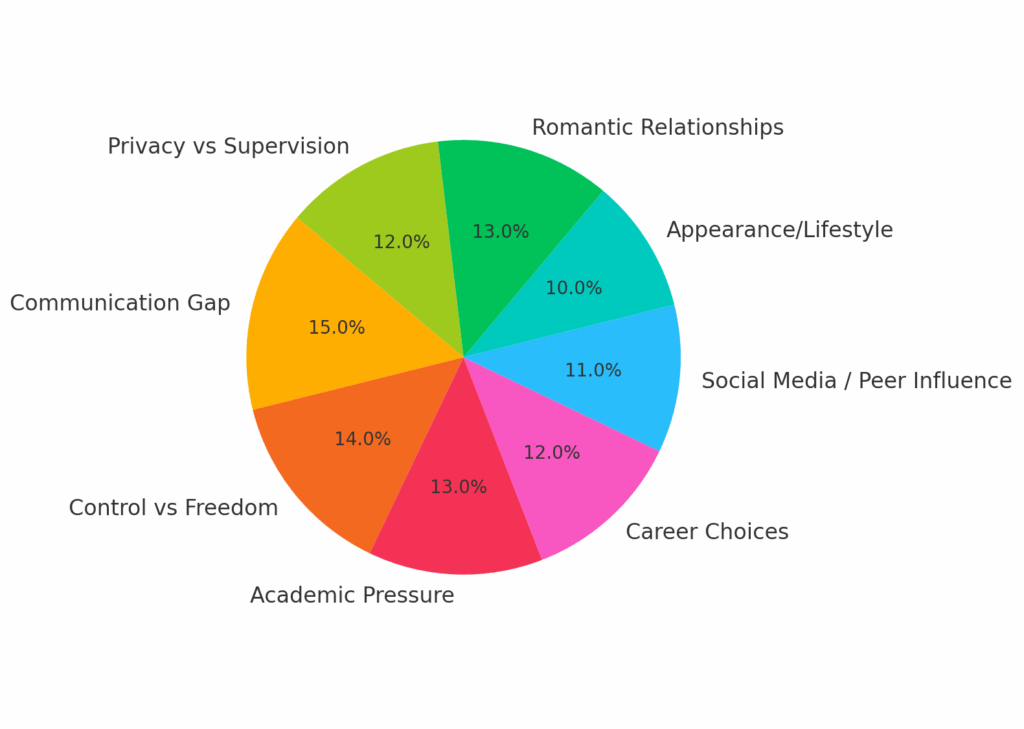
In homes across the globe, though customs and cultures vary, the underlying issues of contention between teenagers and adults are surprisingly the same. After reviewing numerous studies, surveys, and real-world experience, we came up with the most frequent sparks of conflict between parents (or other adults) and teens. These areas of conflict are not coincidental — they follow a pattern associated with natural changes occurring during adolescence.
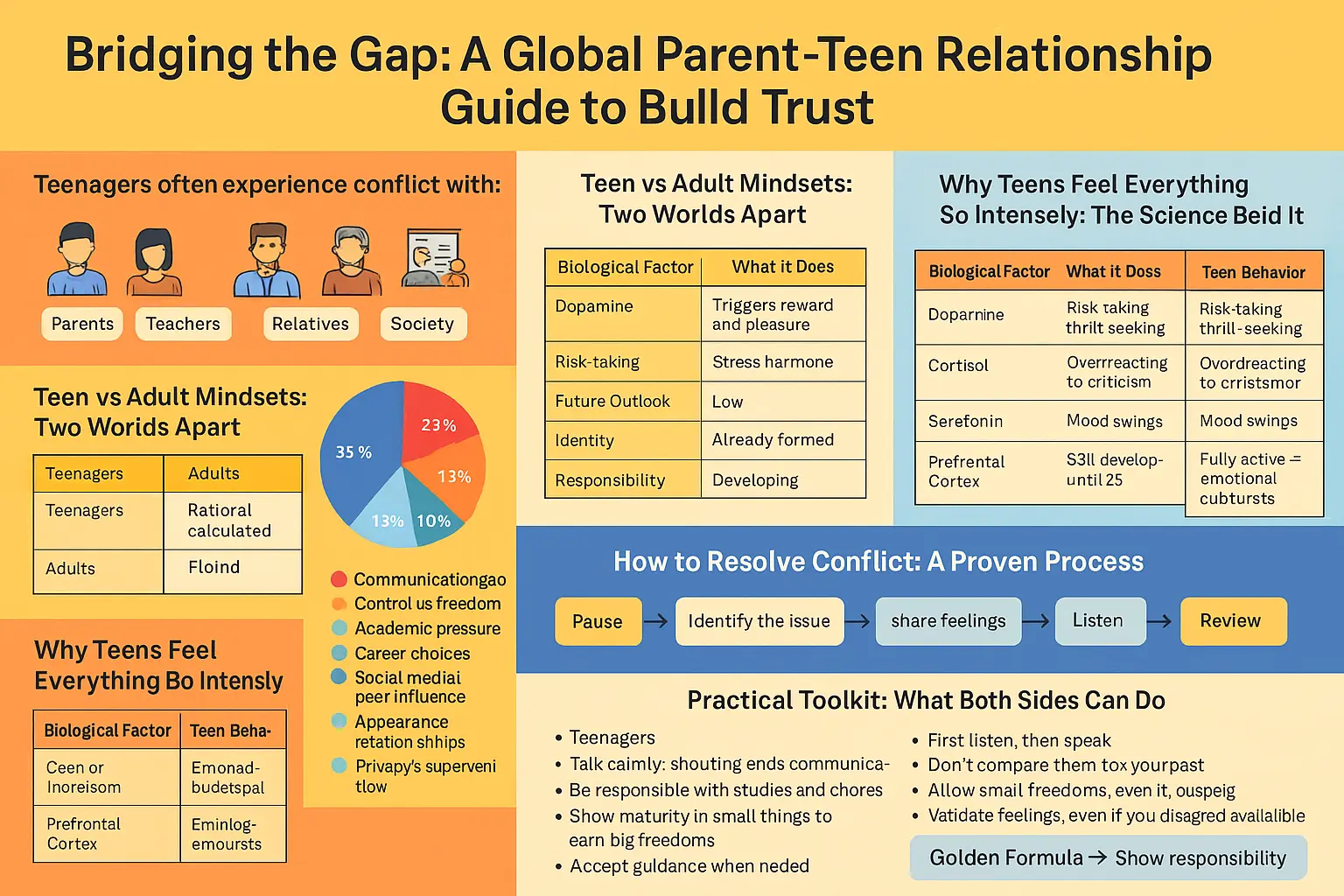
Look at the findings expressed in the pie chart:
- The greatest point of tension is expressing oneself through communication (15%). Adolescents tend to feel that they’re not heard or understood, while adults feel as though their wisdom is being disregarded. This creates tension on both sides — teens pull away or act out, while adults become more rigid or dismissive.
- The second big issue is freedom vs control (14%). Adolescents desire to have or make decisions for themselves regarding where they want to go, what they should wear, and how they want to live. Parents, on the other hand, attempt to establish rules in order to protect them. This creates persistent power struggles and emotional tug-of-war.
- Academic pressure (13%), career decisions (12%), and love relationships (13%) follow. Young people feel pressured by the need to achieve in school and pursue occupations that they are not really interested in. If they say they love or care about someone, they are told that they are “too young.” Such feelings of being muffled or held back can lead parents and adolescents away from each other.
- Other significant triggers are the use of social media, fashion and appearance choices, and the ongoing struggle between privacy versus supervision. Although adults perceive these as distractions or risk-taking, teenagers look at them as identity statements and affiliation.
What’s significant to keep in mind is this:
These are not rebellions or bad acts. Instead, they are marks of emotional, psychological, and social development. A teenager challenging authority, experimenting with appearance, or testing limits is not necessarily trying to be obstreperous — she or he is undergoing necessary developmental changes.
When adults come to understand these behaviors as part of the teenager’s path towards adulthood — and not as personal attacks or failures — the battle can become one of curiosity, patience, and ultimately, understanding.
Teen vs Adult Mindsets: Two Worlds Apart
One of the most common causes of misunderstandings between adults and teenagers is that they are working from entirely distinct mental and emotional systems — nearly two individuals attempting to communicate in different languages.
Teenagers are in the midst of developing their sense of self. They are becoming, which translates into experimenting, testing, questioning, and feeling deeply. They have brains programmed to be present-focused, concerned with what feels good in the moment and with seeking acceptance and excitement. This makes them emotional, acting without foresight, and compelled by the desire to explore.
Conversely, adults operate from a position of experience. Their brain is completely developed. They have learned to make decisions based on reason, caution, and foresight. They have experienced consequences, learned hard lessons, and naturally wish to impart that knowledge to the next generation, frequently in the form of advice and rules.
Here’s a side-by-side comparison to show you how these two ways of thinking differ:
| Aspect | Teenagers | Adults |
| Decision-making | Emotional and impulsive | Rational and calculated |
| Risk-taking | High – open to experimenting | Low – cautious due to life experience |
| Future Outlook | Focused on the present (“now”) | Focused on the future (“what if…”) |
| Identity | Still exploring and developing | Mostly established and stable |
| Responsibility | Growing; still learning consequences | Stable and routine-driven |
| Communication | Want to be heard and understood | Want to give advice and set direction |
This comparison illustrates that both are right — they simply see life differently. Adults are attempting to guard, while teenagers are attempting to learn. Adults use structure, while teenagers seek freedom to learn to be who they are.
The test, therefore, is not in changing minds, but in seeing the differences and creating a bridge of understanding. When teens can see that adults are not attempting to “control” them but are only attempting to spare them hurt, and when adults can see that teens are not being “disobedient” but are merely attempting to develop, a new sense of respect can be in the making.
In short: Adults work from experience and safety. Teens work from emotion and experimentation. Both are correct, but mismatched — and that’s where the gap starts. The answer is empathy and communication, not control.
Why Teens Feel Everything So Intensely: The Science Behind It
Have you ever wondered why teens cry more, fight more, or get so revved up or upset over things that may seem trivial to adults? The answer is deep within their biology. Teen years are a time when the brain experiences one of the most rigorous periods of growth in life — even more rigorous than early childhood.
This is the time of the quick surge of hormones and slow building of significant areas of the brain. These developments don’t influence teens’ physical growth alone — they also influence the way they think, feel, and respond. That’s why a great number of teenagers feel bewildered, misunderstood, overwhelmed, or perpetually emotional. It’s not attitude — it’s science.
Let’s break it down:
| Biological Factor | What It Does | Impact on Teen Behavior |
| Dopamine | Regulates reward, motivation, and pleasure | Teens seek excitement, rewards, and risk-taking |
| Cortisol | The body’s main stress hormone | Overreacts to stress, easily upset by criticism |
| Serotonin | Helps with mood regulation | Causes mood swings, irritability, or sadness |
| Prefrontal Cortex | Responsible for planning, judgment, impulse control | Still developing until mid-20s; leads to impulsive decisions |
| Amygdala | Processes emotions like fear, anger, and joy | Fully active in teens; leads to intense emotional responses |
Here’s what this translates into in plain language:
- Dopamine surges drive teenagers to pursue “fun” activities — social media validation, parties, video games, or even risky escapades — because their brain hungers for reward and pleasure more intensely than ever before.
- Cortisol surges rapidly in response to stress, so a minor argument or criticism can be experienced as a personal attack.
- Serotonin levels change frequently, causing mood swings — teenagers can be happy one minute and seriously depressed the next, sometimes without knowing why.
- The part of the brain responsible for getting you to think first before acting, the prefrontal cortex, is still in the process of being built. It takes until age 24–25 to develop completely. This is the reason why teenagers are able to act on impulse without thinking of consequences — not because they are irresponsible, but because their impulse control is still developing.
Meanwhile, the amygdala, the brain’s emotional center, is fully active and dominant. This means emotions like anger, fear, and excitement are felt more intensely and quickly than adults experience them.
Summary: Teenagers are not “overreacting” deliberately. Their brain is designed to experience feelings before thoughts. That’s why a little problem can seem like a huge drama. It’s not a weakness — it’s a standard part of adolescence.
By recognizing these biological shifts, teens and adults can become more patient, understanding, and less reactive. Parents can provide calming support rather than punishment, and teens can learn to manage emotions — with the knowledge that what they’re feeling is temporary and controllable.
It’s a potent tool for de-escalating conflict and creating emotional maturity.
Timeline of Teenage Hormonal Development
The adolescent years are not all about getting taller or growing up physically — they’re a total overhaul of the brain, body, and emotional landscape. The reason why this period is so frustrating is that the emotional centers of the brain mature more quickly than the rational centers. Teens, therefore, experience strong emotions but are unable to process them properly.
Knowing how this process goes down over time can make teens and adults more patient and ready. Let’s follow this important timeline of development:
- Between the ages of 10 to 12, puberty starts. Hormonal changes initiate, particularly from the pituitary gland, resulting in growth spurts and mood swings. Children begin to become more sensitive and reactive — a byproduct of mood changes they may not even be aware of.
- 13-15 is the age when the brain is awash with sex hormones (testosterone and estrogen) and dopamine surges. At this phase comes a powerful desire for peer approval, excitement, and thrill-seeking activities. Teenagers can be fixated on friends, being popular, or social networking — not to push boundaries, but because their brain is pursuing acceptance and excitement.
- At 16-18, teenagers start looking for themselves. But their prefrontal cortex (the decision center in the brain) is not yet developed. The emotional side of their brain — particularly the amygdala — is still predominant. This leads to frequent authority battles with parents and teachers as teenagers demand freedom but have difficulty with consistency and controlling impulses.
- Between 19 to 21 years, a balance begins to assert itself gradually. The emotional whirlwinds calm down slightly, and reason starts catching up. Teens (now young adults) begin to think more rationally about their life ahead, make wiser decisions, and have greater control over their feelings. Occupational interests tend to become more defined at this stage.
- Lastly, at 22 to 25 years old, the prefrontal cortex is fully developed. This is when emotional control, reflective decision-making, planning for the future, and responsibility kick into full gear. The adult brain is now ready to manage complicated feelings and life decisions in a stable manner.
Here’s this shift summarized on a timeline:
| Age Range | Biological Milestone | Visible Effects |
| 10–12 | Start of puberty; hormonal mood shifts | Emotional bursts, sudden anger, physical body changes |
| 13–15 | Surge in sex hormones; dopamine increases | Risk-taking behavior, peer pressure, attraction, curiosity |
| 16–18 | Identity search; emotional brain more active | Frequent clashes with adults, rebellion, mood swings |
| 19–21 | Beginning of brain balance; logical thinking improves | Clearer career interests, more stable moods |
| 22–25 | Prefrontal cortex fully matures | Stronger impulse control, better decisions, maturity |
Takeaway: Up until the mid-twenties, the brain of a teenager is governed more by feelings than reason. Their responses, danger, and depth of emotions are not expressions of immaturity — they are scientific markers of a developing brain.
When adults see this timeline, they are able to move from criticism to empathy — understanding that each stage of adolescence is a crucial stepping stone towards adulthood. Similarly, teenagers can understand better why they feel the way they do — and how to work with what they’re feeling, rather than against it.
How to Resolve Conflict: A Proven Process
In each home, disagreements are sure to occur, particularly among teenagers and adults. However, the way we deal with them decides if they create permanent damage or if they lead to greater understanding.
Most conflicts do not necessarily have to be wars. They get out of control when emotions take over, and shouting supplants listening. The best news? There’s a step-by-step method that will transform conflict into connection – not through coercion, but through empathy and respect.
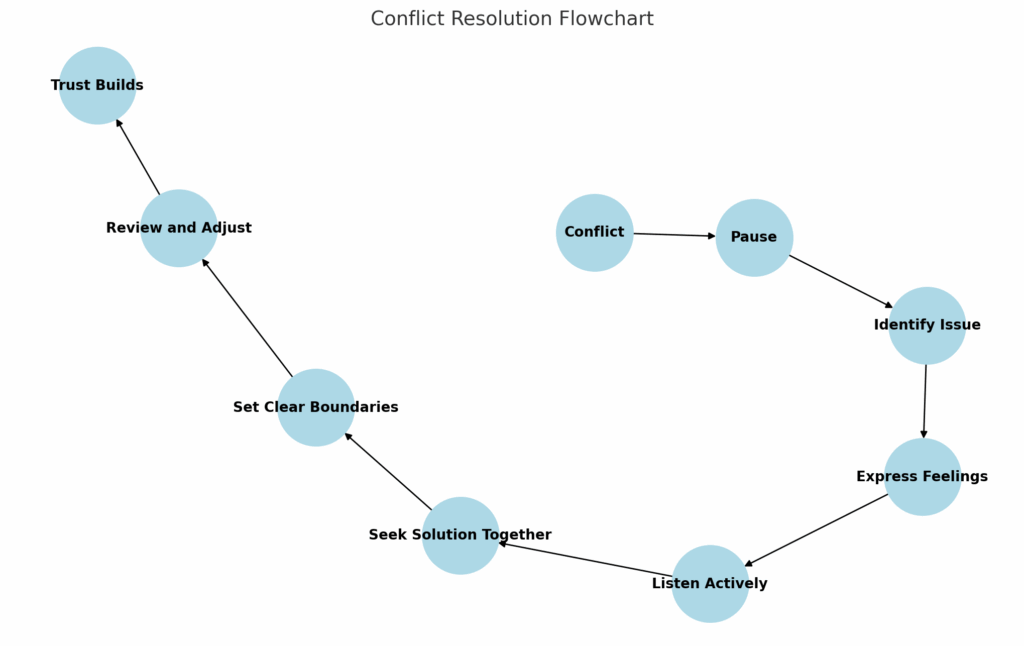
1. Pause – Step Back Before Responding
The first and foremost rule is to step back before reacting. It is so easy to say nasty things when emotions are high, but those words do more harm in the long run.
Tip: Take a few deep breaths, count to 10, or politely excuse yourself by saying, “Can we speak in 10 minutes? I need to think.”
2. Identify the Problem – Be Specific, Not General
It is common for conflicts to escalate because we load several issues into the same conversation. Rather than blame or criticism, identify the very specific problem you are trying to resolve.
Example: Say, “I felt hurt when you didn’t call after staying out late,” rather than “You never care about the rules!”
3. Share Feelings – Use “I” Statements, Not Accusations
Say how you feel without attacking. Don’t say “You always ignore me,” say “I feel left out when you don’t talk to me after school.” That subtle change in wording can do a lot to get the other person to react differently.
Why it works: “I” statements convey emotion, not blame. People react more positively when they don’t feel attacked.
4. Listen Actively – Understand Before Responding
Listening is more than keeping quiet and letting the other person have their say. It’s about paying him full attention — and attempting to see the world from his perspective.
Active listening tips: Nodding, maintaining eye contact, and uttering statements such as “I hear you” or “That must have been hard for you.”
5. Solve Together – Create a Win-Win
After both sides are heard, it’s time to work together on a solution. This isn’t about who gets their way or who loses — it’s about discovering a compromise that honors both views.
Ask: “What can we do differently so we’re both okay with it next time?” or “How can we meet halfway?”
6. Set Boundaries – With Love and Logic
Boundaries and rules are necessary, particularly for safety and organization. But when presented without explanation, they’re perceived as punishment.
Instead of: “Because I said so,” say: “This rule is in place to keep you safe, not to prevent your fun.”
Boundaries become stronger when they’re explained and shared, not imposed.
7. Review and Adjust – Remain Flexible
Families grow, and so should the rules. What worked six months ago might feel too strict or outdated today. Make time to review your agreements together and adjust when needed.
Example: “You’ve been responsible for the past three months. Maybe it’s time to push curfew by an hour.”
Visual Summary of the Conflict Resolution Process:
Conflict ➞ Pause ➞ Identify Issue ➞ Express Feelings ➞ Listen ➞ Solve Together ➞ Set Boundaries ➞ Review ➞ Trust Builds
This cycle of calm communication doesn’t simply fix one fight — it sets the stage for a healthier, more respectful relationship in the long run.
Key Takeaway
Conflict is inevitable. But with empathy, patience, and respectful communication, it is a gateway to greater understanding, not resentment. When both adults and teenagers are committed to this process, they build a household where each voice is listened to, and each issue can be resolved.
Practical Toolkit: What Both Sides Can Do
Conflict resolution is not simply a matter of cooling off after a fight — it’s a matter of altering everyday habits, better communication, and respect in the little things. When both teenagers and adults own the responsibility of building peace, it’s possible to create a home where both voices are heard.
Let’s walk through some simple, actionable steps both parties can use to decrease conflict and increase trust:
What Teenagers Can Do:
Teens tend to feel as though their independence is being governed. But the best way to gain more independence is to demonstrate that you can manage it. By behaving mature, composed, and reliable in your daily behavior, you establish trust without having to fight for it.
Below are some strong but straightforward things teens can do:
Speak calmly, not emotionally.
When you yell, adults will shut down or become defensive. To be heard, talk in a clear, respectful voice even if you’re angry.
Be responsible for studies and chores.
Adults respect those who manage their responsibilities without reminders. Be reliable with deadlines at school, homework, and home tasks — not to impress, but to prove you can take care of yourself.
Demonstrate maturity in small choices.
Make your clothes, friends, and words count. They are little things but big messages to adults that you’re becoming an adult.
Accept advice when it’s a good idea.
At times, adults offer advice because they care. You do not need to accept everything, but you must be willing to hear with an open mind.
Negotiate, don’t command.
If you desire greater freedom, state your reasons and propose compromises (e.g., “I’ll call when I arrive, and return by 10.”). Assertive communication is always stronger than emotional demands.
What Parents and Adults Can Do:
Adults have more control in the relationship, so their behavior sets the tone. Teens need to be heard, not criticized. When adults use empathy rather than authority, trust comes naturally.
Here are some things parents can do:
Listen first, then talk.
Teenagers do not always articulate clearly, but they still need to be heard. Allow them to get out what they are trying to say before you answer. Validation precedes correction.
Don’t compare with your past.
You stating, “When I was your age…” will not help. Things are different now. Your teenager is confronting new issues in a new world. Instead, attempt to relate rather than compare.
Grant small liberties — with responsibility.
Trust is stair-step: it’s built step at a time. Allow them an opportunity to show responsibility and check in supportively, not spying or controlling.
Validate their emotions, even when you disagree.
Saying “I understand you’re upset” acknowledges that they are upset. Even if you don’t agree with the reasons why, validate their feelings as real and legitimate.
Respect their privacy but remain emotionally available.
Teens require space to develop, but they also need to understand that you are available if they trip up. Knock on the door as you enter their room, but keep the door to your heart ajar.
The Golden Formula for Harmonious Relationships
Behind it all, teens and parents alike desire the same things: freedom, safety, respect, and love — but they communicate them differently.
Let’s deconstruct the fundamental thinking of both sides:
| If You’re a Teen | Your Goal | Your Key Action |
|---|---|---|
| You want freedom | Be seen as mature | Show responsibility consistently |
| If You’re a Parent | Your Goal | Your Key Action |
| You want safety | Protect without control | Show trust gradually |
Remember:
- Teens need freedom. They earn it if they behave responsibly.
- Parents long for safety. If they give trust, they build it.
When both sides take small steps in the right direction, big changes happen.
Knowledge and peace start with doing, not arguing.
Conversation Starters: When Topics Feel Tough
One of the toughest aspects of any teen-parent relationship is initiating the discussion — particularly when it involves something sensitive. Whether it’s staying out late, dating, career ambitions, or use of screens, fear of disagreement tends to keep both parties from opening their mouths at all.
But silence can make things even more distant.
The key is to use words that invite a response, not trigger defense. The right sentence can open a door. It tells the other person, “I’m here to talk, not fight.”
Below are some effective dialogue starters which can calm tension and foster positive conversation:
| Topic | Try Saying This | Why It Works |
| Outing | “How can we make this outing both fun and safe?” | It shows you care about their fun, but also want to set boundaries together. |
| Career | “Let’s look at all your possibilities, including the practical ones.” | It encourages working together instead of insisting on a decision, being open. |
| Dating | “We believe your instincts. Just vow to tell us if something bothers you.” | It recognizes their feelings without closing down communication. |
| Phone Use | “Want to set screen limits together that feel fair?” | It makes the teen feel involved in decision-making rather than being controlled. |
These questions are not about having all the answers — they’re about making space for honest, two-way talk. They make teenagers feel heard and adults feel respected.
The magic lies in the tone. Deliver these lines in mild, true interest — not suspicion or sarcasm.
Even if that initial conversation is stilted, it seeds an idea. Gradually incorporating open-ended, respectful questions in conversations develops a home culture of trust — where both sides feel secure to listen and speak.
Remember: A single caring sentence can change the whole tone of a difficult topic. Don’t fear the discussion — lead it with compassion.
Phrases That Hurt (And Should Be Avoided)
Words carry weight — especially in charged conversations among teens and grown-ups. Certain words, uttered during frustration or anger, have the ability to cut off communication, inflict emotional injury, and destroy trust that may take years to restore. Such words might appear to be a quick solution to stop an argument, yet they drive the other individual further away.
Let’s look at some of the most common insulting words, why they hurt, and what to use instead:
❌ “You never…” / “You always…”
These black-and-white words are usually exaggerations, and they get others feeling attacked or unfairly criticized. For example, “You never listen to me!” doesn’t begin a conversation — it brings a defensive response like “That’s not true!”
Better alternative:
✅ “I feel like I’m not being heard when I attempt to explain my perspective. Can we discuss it calmly?”
❌ “Because I said so.”
This response shuts down the conversation without any explanation. It presents the adult as authoritarian and belittling, and the teen feels powerless and unimportant.
Better alternative:
✅ “I feel like I’m not being heard when I attempt to explain my perspective. Can we discuss it calmly?”
❌ “You’re immature.”
This label demeans a teenager’s self-esteem. Even if it is spoken with frustration, it can greatly damage their confidence. Instead of altering behavior, it leads to shame and resentment.
Improved alternative:
✅ ” I believe that choice may not be the most responsible one. Let’s work through this together.”
❌ “You don’t know anything.”
This statement closes the door to learning. It’s a method of dismissing the teen’s point of view as a whole, making them feel dumb or inept, when in reality, they are attempting to learn and develop.
Better alternative:
✅ “I know you’re trying to understand. Let me explain it a different way so it makes more sense.”
❌ “I don’t care.”
This can be said in anger, but to an adolescent, it reads like rejection. Even if not meant, it says that their experience, needs, or feelings are not important to the adult — and that is emotionally devastating.
Improved option:
✅ ” I’m angry now, but that doesn’t mean I don’t care. Let’s discuss this when we’ve both had time to calm down.”
Why These Words Hurt
All of the above statements form what psychologists refer to as emotional blockades. Rather than evoking honesty, they leave the listener feeling attacked, dismissed, or belittled. Over time, these statements can destroy the emotional safety that all relationships require in order to flourish — particularly between parents and teenagers.
Communication is not merely about saying how you feel — it’s also about preserving the dignity of the person with whom you’re communicating.
The Rule of Respectful Communication:
If a sentence labels, blames, or shuts down, it probably hurts. If a sentence explains, invites, or seeks to be understood, it forges trust.
In frustration, it’s fine to step back, breathe, and return later with gentler words. The most important thing is mending the harm and promising better communication down the line.
Growth Plan for Teens: Build Yourself
Use this blueprint to grow into a respected, trusted, and confident individual:
| Skill Area | Action Steps |
| Self-Control | Breathe before reacting. Think ahead. |
| Time Management | Use planners/apps. Don’t overload yourself. |
| Communication | Speak clearly. Don’t be sarcastic or silent. |
| Self-Confidence | Accept failure. Build on your strengths. |
| Healthy Life | Sleep 8 hours. Eat healthy. Avoid addictions. |
| Stress Management | Talk, journal, exercise, or take quiet breaks. |
Formula: Discipline + Expression = Respect
Parent-Teen Peace Agreement
Creating a clear and respectful contract — not one of rule-by-force, but of mutual understanding and joint responsibility — is one of the best methods of conflict diminishment and trust-building in a family. When both parents and teens feel heard and engaged in the decision-making process, it serves as a strong foundation for trust, maturity, and safety on an emotional level.
This idea of a “Peace Agreement” isn’t about control. It’s about developing a system of give-and-take respect — where teens demonstrate that they are willing to behave responsibly, and parents demonstrate that they are willing to provide freedom with guidance, not pressure.
Here is a straightforward, working model to start with:
| Issue | Teen Can Offer | Parent Can Promise |
| Curfew | “I’ll text regularly and share my location.” | “We’ll allow late outings with a reasonable time limit.” |
| Phone Rules | “I’ll avoid using my phone during study hours.” | “We won’t check your phone secretly — we’ll trust you.” |
| Relationships | “I’ll be honest if I’m dating someone.” | “We’ll support you and not judge your choices.” |
| Career | “I’ll research and explore career options fully.” | “We’ll support your passion and help plan practically.” |
This table illustrates how both parties contribute to the solution. The adolescent contributes behavior based on responsibility, honesty, and trust, while the parent responds with freedom, empathy, and emotional support.
It’s worth noting that agreements such as these only function if they’re carried out with consistency and good intentions. If a teenager honors their word, the parent should honor their word too — and vice versa. This gives way to a system wherein both feel respected and secure.
How this works:
- It grants empowerment to the teen without forsaking guidance.
- It comforts parents without needing to control every step.
- It turns rules into relationships, founded on conversation, not coercion.
Last Thought: Harmony at home isn’t about winning. It’s about both parties growing together. Arrangements like this turn battles into bonds and rules into respect.
Final Secret to Peace
At the core of every rule, eye-roll, argument, or tantrum is one hard truth:
Teenagers need to be trusted.
Parents need their kids to be safe.
These wants are not opposing each other — they’re two sides of the same coin, both created out of love. Adolescents test limits not because they’re trying to break rules, but because they are finding out who they are. They want what they choose, feel, and think to be considered seriously. They want space in which to grow — and they want to know that their voice counts.
Parents, in contrast, are afraid of what might happen. Their advice is seasoned by experience. They’ve witnessed how life can be unpredictable, and their greatest desire is to spare their son or daughter from hurt, defeat, or remorse. That concern usually manifests itself as caution, rules, or worry — not because they don’t have faith in their teenager, but because they care about them so much that they can’t afford to be irresponsible.
So, how do we find a middle ground?
The bridge is constructed with three strong instruments:
1. Open communication – where both parties feel comfortable talking genuinely without fear of being judged.
2. Empathy – where parents attempt to experience what it’s like to be a teenager in today’s world, and teens attempt to grasp why a parent is concerned.
3. Growing freedom – acquired through responsibility and provided in trust.
When teens and adults finally stop pushing against one another and begin to walk toward one another, they establish something beautiful — a relationship not founded in authority or compliance, but in mutual respect and enduring connection.
Remember this:
A trusted teen becomes a responsible adult.
A supportive parent becomes a lifelong friend.
That’s the peace every family deserves — and it begins with understanding.
Official Resources & References
- UNICEF on Adolescent Mental Health
- Harvard Health: Teen Brain
- American Psychological Association – Parenting
- Mayo Clinic: Teen Health
Disclaimer
This article is more than just parenting advice — it’s a global peace guide between generations. Designed with empathy, research, and real-life tools, it helps both parents and teenagers speak the same emotional language. From science-backed explanations to visual summaries and conversation scripts, this guide empowers families to move from conflict to connection. It is not a substitute for professional therapy or psychological consultation. Every family is unique, and responses to conflict vary by personality, culture, and individual experiences. Always consult a counselor or specialist if needed.
Whether you’re a parent, a teen, or an educator — you’ll walk away from this guide with understanding, hope, and actionable steps to build trust in every conversation.