Disclaimer:
This article is a fictionalized representation of a common journey faced by freshers entering the corporate world. It is intended for storytelling, reflection, and motivational purposes. Any resemblance to actual persons, companies, or real-life situations is purely coincidental. The article discusses corporate life in a general tone, and not every experience will apply to all. Reader discretion is advised, especially for those sensitive to themes of workplace stress, competition, and survival tactics. Always seek professional advice before making career-related decisions. The content herein is written for engagement and educational reading, not professional HR or career consultation.
End of College: The Beginning of Reality
When college ends, a new life begins, not one of freedom, but of responsibility, pressure, and a silent race that never really ends. I still remember standing outside the university gate on my last day, holding a plastic folder filled with my degree, internship certificates, and a lot of hope. That hope, as I would soon learn, had no place in the harsh hallways of corporate life. This is the real story of a fresher’s journey into the ruthless terrain of corporate culture, the truth about hardly getting a job, surviving in corporate politics, and eventually, unknowingly, becoming a corporate brat.
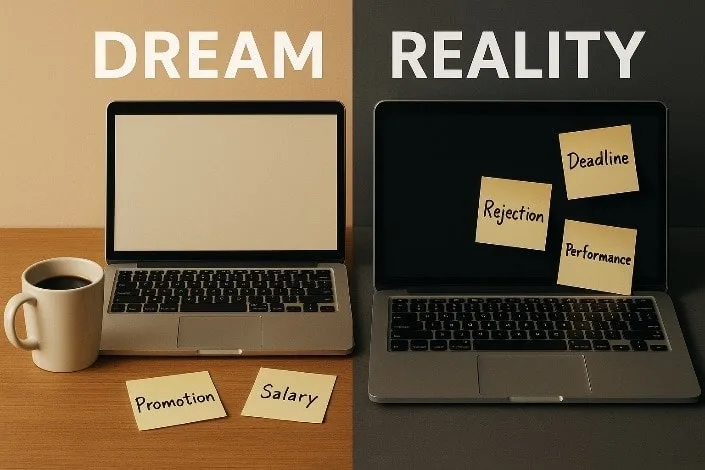
When I was in college, the dream was always shiny. Suits, laptops, coffee mugs, salary credits, Friday parties, and promotions that’s what we saw in movies. Nobody talked about the rejections, the endless unpaid internships, the ego battles, the boss who doesn’t like your face, or the politics in the pantry over who gets the clean mug. The idea of being in the corporate world felt like entering a different class of society you start imagining a life where your job defines your identity, your email signature is your pride, and your Monday outfit matters more than your personality. But first, you must get the job. And that’s where the horror truly begins.
The Resume Wars and Silent Rejections
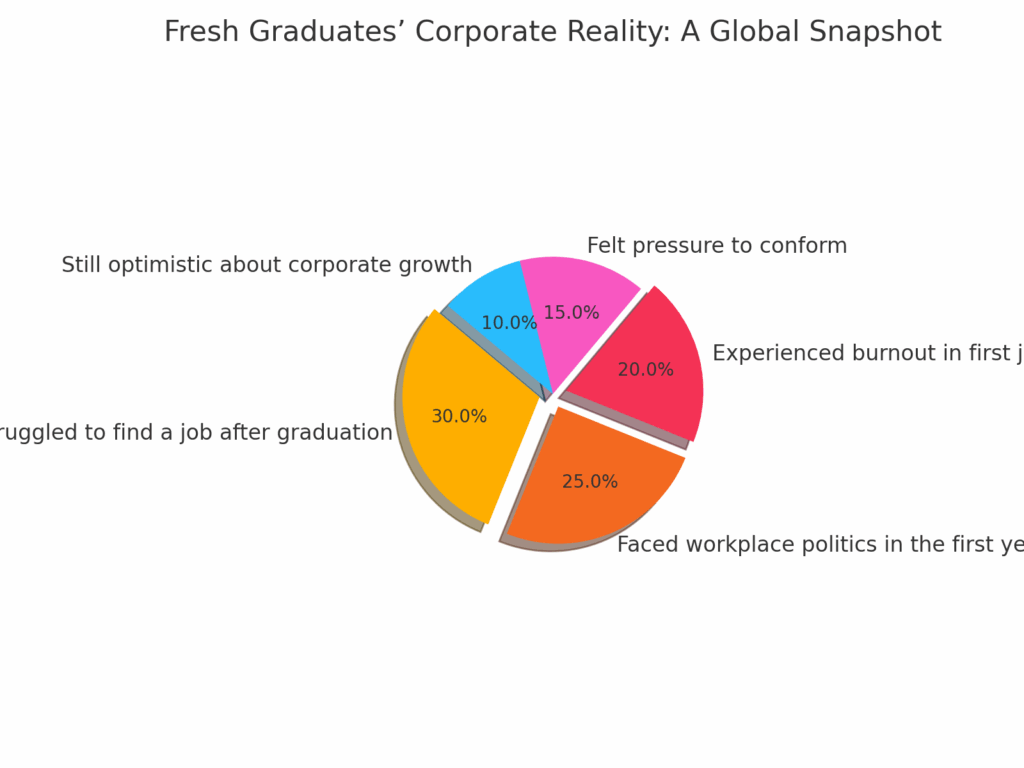
I applied to over seventy companies after college. I remember preparing different versions of my resume, like I was preparing for war. Creative resume, technical resume, one-page resume, resume with photo, resume without photo, ATS-friendly resume, you name it, I made it. I watched interview tips videos, practiced mock interviews, and updated my LinkedIn bio twenty-seven times. Still, all I got were rejection emails, most of them automated. “Thank you for applying, but we’ve decided to move forward with other candidates.” I began to hate that line. It would flash in my inbox like a cruel joke. Behind every rejection email is a person silently questioning my worth. My parents started asking every day, “Any job yet?” My friends who got placed during campus drives moved into cities, sharing stories about their new desks and HR policies. I was sitting in my bedroom in the same pajamas for days, hardly getting a job despite all the effort.
The First Job: A Victory That Didn’t Feel Like One
And then, after nearly five months, I cracked one. A small IT firm offered me an entry-level role. The pay wasn’t great, the office wasn’t glamorous, but it was a start. I signed the offer letter like I was signing a peace treaty after a long war. I didn’t know then that the real war was just beginning. I stepped into the corporate world, excited and nervous, with big dreams in my backpack and a lunchbox packed by my mom. I wore my best formal shirt on day one, hair neatly gelled, shoes polished, not realizing that in a few weeks, my shirt would be crumpled by stress, my hair would be undone by deadlines, and my shoes would feel too tight to run through the madness of office life.
The first few days were training. We were a batch of freshers, all smiling and awkward. We exchanged names and LinkedIn profiles. For a moment, it felt like college again, the same energy, new friendships, group selfies. But as soon as we were deployed to different departments, the atmosphere changed. The office floor wasn’t a friendly place. Everyone was busy typing, clicking, and calculating. No one had time to help a newcomer. I remember asking a senior how to raise a ticket, and he looked at me like I’d asked for his salary. That was my first lesson in the corporate world: you have to figure out most things yourself.
The pressure started mounting from the second week. My team lead expected me to understand everything in one go. I was assigned tasks that made no sense, asked to sit in meetings where the acronyms flew over my head. “Just Google it,” someone told me once. That phrase became my best friend and worst enemy. I googled terms like SLA, KPI, stakeholder mapping, and business continuity planning — terms I had never heard in college. Half the time, I pretended to understand just to avoid embarrassment. That’s what being a fresher in corporate means — nodding with fake confidence while your brain is having an identity crisis.
Welcome to Politics 101
And then came the politics. I used to think politics only existed in parliament and WhatsApp groups. But corporate politics is a different beast. It’s quiet, subtle, and poisonous. People make alliances in pantry rooms, butter up managers in elevator rides, and throw colleagues under the bus in the name of feedback. I once made the mistake of sharing a new idea in a team meeting. The next day, my manager praised another team member for “suggesting” that same idea. That was the day I learned another corporate lesson: speak less, observe more. If you’re too smart too early, someone else will carry your idea to promotion while you stay behind filling spreadsheets.
Faking It to Make It. Surviving in corporate politics became my everyday mission. I started learning the tricks, complimenting the boss’s new shirt, laughing at dry jokes during stand-ups, and staying five minutes extra every evening just to show dedication. It felt fake, but necessary. Authenticity doesn’t always win here; visibility does. If you’re not seen, you’re forgotten. If you’re too visible, you’re targeted. It’s a tightrope walk. One wrong word, one email sent without double-checking, and your name would be whispered in corners as “the guy who messed up.” I began to realize that surviving in corporate politics was not a skill they teach in business school; it was an art form built on instincts, timing, and strategic silence.
Slowly, I became a part of the system. The same system I used to criticize. I started enjoying the paycheck, even though it disappeared by the 20th of every month. I waited for the 1st like it was a festival. I started sharing memes about corporate life, joined the complaints in lunch breaks, and marked “active” on Teams even while watching Netflix. I became fluent in corporate phrases like “loop me in,” “let’s circle back,” and “per my last email.” Without realizing it, I was becoming a corporate brat.
The Cost of Becoming a ‘Corporate Brat’
What does it mean to become a corporate brat? It means slowly losing the version of yourself who once questioned everything. You stop challenging, you start adjusting. You stop dreaming, you start delivering. You no longer ask “why,” only “by when.” You start caring more about your performance rating than your mental health. You find pride in replying to emails at midnight, in being the “go-to” guy even on weekends. You start speaking in calendar invites and task lists. You stop living, and you start functioning.
I remember one day, my father asked me what I had been working on the whole week. I opened my laptop to show him, and I realized — I didn’t even know how to explain it in normal language. My work had become a maze of jargon and meaningless deliverables. That was the day I asked myself — is this what I studied for? Is this what I wanted to be? But I couldn’t stop. The rent had to be paid. The EMIs had started. The credit card had already seen two sales. I was trapped in the system that welcomed me with a smile and tied me with a badge.
But even in this chaos, something changed. I learned things I never knew I needed. I learned how to write professional emails, how to keep calm when someone steals your credit, and how to manage time when your calendar looks like a battlefield. I learned diplomacy, resilience, and patience. I saw people break down in the washrooms and come out with a smile. I saw kindness in colleagues who stayed late to help, and cruelty in bosses who sent passive-aggressive emails. I saw friendships born in shared frustration and careers destroyed by office rumors. And somewhere, I found my own place in this twisted jungle.
Years have passed since that first job. I’ve switched companies, changed domains, and handled teams. But that feeling of being a fresher, of being lost, never really fades. Every time I onboard a new team member, I see the same fear I once had. And I try, in my own way, to make them feel seen. Because I know how hard it is — to hardly get a job, to survive in corporate politics, and to wake up one day realizing you’ve become exactly what you used to laugh at — a corporate brat.
But maybe that’s not entirely a bad thing. Maybe becoming a corporate brat means adapting to survive. Maybe it means learning how to play the game without losing your soul completely. Maybe it means finding small victories in emails that begin with “Great job!” and in the rare “Thank you” from a client. Maybe it means understanding that adulthood doesn’t come with clarity — it comes with deadlines.
Final Reflection: Maybe It’s Not All Bad
Today, when I look back at that nervous fresher with a plastic folder and wide eyes, I want to tell him — Hang in there. You’ll fall, but you’ll also rise. You’ll hate it, but you’ll also laugh. You’ll become part of a machine, but you’ll still find moments of humanity. And someday, when a fresher walks up to you asking how to raise a ticket, you’ll smile, not because you feel superior, but because you remember.
This is not a fairy tale. It’s not a motivational speech. It’s the truth. The truth about becoming someone you never thought you’d be — and maybe, just maybe, learning to be okay with that.
“The price of anything is the amount of life you exchange for it.”
— Henry David Thoreau
Reference Links:
- World Economic Forum – The Skills Companies Need Most in 2025
https://www.weforum.org/agenda/2020/10/top-10-work-skills-of-tomorrow - Harvard Business Review – Navigating Office Politics
https://hbr.org/2022/11/how-to-navigate-office-politics - Forbes – What It Means To Be A ‘Corporate Professional’ Today
https://www.forbes.com/sites/forbescoachescouncil/2021/09/29/ - LinkedIn Blog – First Job Anxiety and How to Cope
https://www.linkedin.com/pulse/why-your-first-job-so-scary-what-do-about-it-amy-blaschka - McKinsey – Gen Z entering the workplace
https://www.mckinsey.com/featured-insights
Your words unfold with contemplative elegance, revealing layered meaning gradually. Each sentence contributes to a reflective cadence, fostering insight, presence, and a deep, enduring resonance in the reader’s experience.