Introduction: One Movement, Many Minds
Progressive individuals everywhere struggle for change — for justice, equity, innovation, and fairness. But the term “progressive” does not describe a single kind of person. It’s more like a family of attitudes, each with their own purpose, style, and vision.
Some hope to reform what is broken, others to tear it down. Some turn to empathy and human rights, while others have faith in science and technology. Some struggle for the environment, some for cultural diversity, and others for economic justice. All of them, though, share an expectation of forward movement.
This article breaks down the ten most typical progressive mindsets, how they think, what they enjoy, what they bring in strengths, and how collectively, they can remake the world.
The 10 Progressive Mindsets
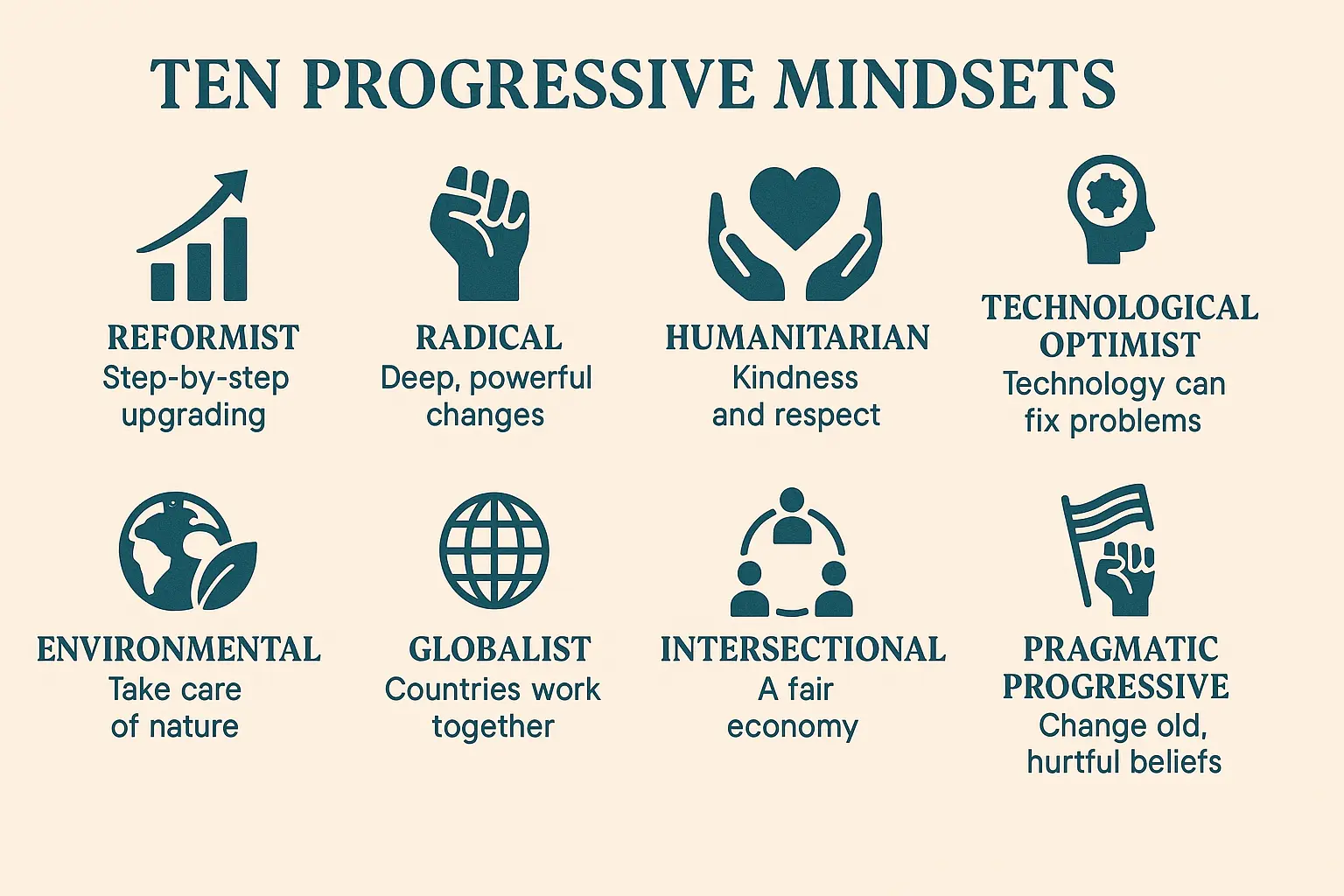
1. Reformist Mindset
- Believes in: people who belong to this mindset believe in Step-by-step upgrading of the systems that are existing.
- Focus: Policy reforms, legal regulation, institutional repair.
- Example: They usually advocate for better healthcare laws, not dismantling the healthcare system.
2. Radical Mindset
- Believes in: People with a radical mindset think that if a system is broken, it should be replaced completely, starting from the root.
- Focus: They want deep, powerful changes and often challenge the way things currently work.
- Example: They may strongly support ideas like giving everyone a basic income or changing how wealth is shared in society.
3. Humanitarian Mindset
- Believes in: Everyone deserves kindness and respect.
- Focus: Helping people get equal rights and fair treatment.
- Example: Speaking up for refugees or standing against unfair treatment of others.
4. Technological Optimist Mindset
- Believes in: Technology can fix many problems in the world.
- Focus: Using smart tools like AI, clean energy, and the internet for all.
- Example: Promoting renewable energy and digital learning platforms, or you can say supporting solar power or online learning for kids.
5. Environmental Mindset
- Believes in: We must take care of nature to save our planet.
- Focus: Fighting climate change, using less waste, and living green.
- Example: Living a zero-waste life or saving forests and animals.
6. Globalist Mindset
- Believes: Countries should work together to solve big problems.
- Focus: Helping each other through global rules and support.
- Example: Taking part in world agreements on climate or health care.
7. Intersectional Mindset
- Believes in: People can face unfair treatment in many ways at once.
- Focus: Things like race, gender, money, or disability all matter.
- Example: Helping women of color become leaders in politics.
8. Economic Justice Mindset
- Believes in: Everyone should get a fair share of money and rights at work.
- Focus: Better pay, fair taxes, and support for people in need.
- Example: Asking for higher minimum wages and free schooling for all.
9. Cultural Progressive Mindset
- Believes in: Society should change old, hurtful beliefs and include everyone.
- Focus: Equal rights for LGBTQ+ people, fairness between genders, and better stories in media.
- Example: Speaking out against unfair roles in movies or fighting for equal rights in TV and music.
10. Pragmatic Progressive Mindset
- Believes in: We should aim for big goals but take small, smart steps to get there.
- Focus: Realistic plans, working with others, and practical changes.
- Example: Supporting climate actions that can happen now, even if they’re not perfect yet.
Do They All Think the Same? Not Quite.
Although all progressives hold similar values such as fairness, openness, and inclusion, their interests and inclinations are vastly different.
| Mindset Type | Main Focus | Likings / Interests | Common Traits |
| Reformist | Systemic improvement | Policy, law, negotiations | Logical, diplomatic |
| Radical | Structural overhaul | Activism, revolutionary theory | Bold, idealistic |
| Humanitarian | Human welfare | Volunteering, storytelling | Empathetic, kind |
| Tech Optimist | Innovation | Startups, clean energy | Curious, futuristic |
| Environmental | Sustainability | Nature, documentaries | Conscious, responsible |
| Globalist | Global cooperation | Travel, diplomacy | Adaptive, open-minded |
| Intersectional | Layered equality | Diversity forums | Inclusive, analytical |
| Economic Justice | Fair wages | Labor organizing | Fairness-driven |
| Cultural Progressive | Representation | Art, films, social change | Expressive, creative |
| Pragmatic | Balanced reforms | Real-world problem solving | Strategic, practical |
Within the same frame of mind, individuals are not the same. Two environmentalists care the same about climate change — but one is an activist farmer, and another is a climate policy researcher.
Real-Life Examples to Understand Better
| Mindset | Example Role | What They Do | What They Like |
| Reformist | A government policy analyst | Works on drafting public health or education laws | Enjoys reading policy papers and analyzing data |
| Radical | A grassroots social activist | Organizes protests for economic reform | Passionate about revolutionary books and speeches |
| Humanitarian | A nonprofit education worker | Builds schools for underprivileged communities | Enjoys volunteering and personal storytelling |
| Technological Optimist | A climate-tech startup founder | Develops AI tools for renewable energy access | Loves tech expos, podcasts, and coding |
| Environmental | A conservation biologist | Works to protect endangered ecosystems | Enjoys hiking, zero-waste living, and documentaries |
| Globalist | An international diplomat | Negotiates cross-border agreements on climate change | Follows global news, enjoys travel and languages |
| Intersectional | A university professor in gender studies | Teaches about race, class, and identity politics | Interested in TED Talks, academic journals |
| Economic Justice | A labor union organizer | Advocates for higher wages and fair labor practices | Enjoys organizing meetings and studying equity |
| Cultural Progressive | A filmmaker or visual artist | Creates documentaries on underrepresented communities | Loves art festivals, storytelling, and cinema |
| Pragmatic | A public policy manager | Implements welfare programs at local levels | Enjoys finding real-world solutions and compromises |
How to Identify a Mindset
Ask:
- What is the cause they are most passionate about?
- Do they believe change must be rapid or gradual?
- Are they attracted to law, technology, people, stories, or activism?
- Do they act locally or globally?
- Are they feeling, practical, or analytical?
The responses usually tell us their fundamental progressive thinking.
Self-Test: Discover Your Mindset
Answer honestly:
1. When you see a problem, you think:
- Fix the system (A), Overhaul it (B), Help people directly (C), Use tech (D), Save the planet (E), Work globally (F), Who is most oppressed? (G), Are workers treated fairly? (H), Change the narrative (I), What’s practical now? (J)
2. Free time?
- Policy reading (A), Protesting (B), Volunteering (C), Tech expos (D), Nature walks (E), Travel (F), Diversity events (G), Labor meetings (H), Art shows (I), Bridge-building (J)
3. Frustration triggers:
- Slow systems (A), Denial of problems (B), Human neglect (C), Misuse of tech (D), Nature destruction (E), Lack of global unity (F), Ignoring intersectionality (G), Inequality (H), Harmful media (I), No consensus (J)
Tally up your top choices to identify your dominant mindset.
Why Diverse Progressive Teams Work Best
Every mindset adds something unique:
| Mindset | Strength | Watch Out For |
| Reformist | Structure | May be too slow |
| Radical | Vision | May alienate center |
| Humanitarian | Compassion | May ignore system needs |
| Tech Optimist | Innovation | May forget ethics |
| Environmental | Long-term thinking | May conflict with jobs |
| Globalist | Diplomacy | May overlook local needs |
| Intersectional | Deep fairness | May overcomplicate |
| Economic Justice | Worker focus | May deter business |
| Cultural Progressive | Cultural healing | May clash with tradition |
| Pragmatist | Balance | May overcompromise |
The best teams have:
- 1 visionary (Radical, Tech)
- 1 emotional anchor (Humanitarian)
- 1 realist (Reformist, Pragmatic)
- 1 cultural/global thinker (Cultural, Globalist)
Managing Conflict Between Mindsets
| Conflict | Resolution |
| Radical vs. Reformist | Combine bold ideas with feasible plans |
| Humanitarian vs. Tech | Let empathy guide innovation |
| Environmental vs. Economic Justice | Create green jobs alongside green policies |
| Cultural vs. Pragmatic | Change norms while watching public mood |
| Intersectional vs. Globalist | Design global policies with local inclusivity |
Leadership Guidebook for Forward-Thinking Leaders
The 6 Golden Leadership Habits:
1️ Identify Every Strength
Ask: “What does this person see that no one else sees?”
2️ Make Two-Level Plans
- Short-term: Reformists, Humanitarians, Pragmatists
- Long-term: Radicals, Tech Innovators, Environmentalists
3️ Get Conflict Out of the Way
Pilot projects, ethics boards, dual committees
4️ Anchor to Shared Values
Justice, fairness, equity, sustainability
5️ Cross-Pollinate Mindsets
Tech + Humanitarian = Ethical Innovation
Radical + Reformist = Big ideas + Stable base
6️ Progress Over Perfection
Small wins add up to transformation
Final Thought
One way of thinking won’t change the world. Together, however, through working with each other, hearing each other out, and leading, progressive thinkers can transform dreams into policy and ideals into action.
Progress isn’t one road — it’s many roads leading forward.
The Progressive Mindsets Map

Progressive Mindsets Map — Explained
This map divides progressive mindsets into three broad areas:
1️ SYSTEM
These mindsets are interested in how institutions, policy, and power are built, operated, and altered.
- Reformist: Aims to slowly improve systems by way of legislation, policy, and reform.
- Radical: Calls for replacing or fundamentally changing systems that are too ruptured to repair.
- Economic: Concerned with economic justice — such as equitable pay, the distribution of wealth, and poverty reduction.
- Pragmatic: A practical approach balancing ideals with what is politically and socially possible in real-world situations.
2️ SOCIETY
These attitudes are all human-centered, all about culture, identities, and social inclusion.
- Humanitarian: Focuses on empathy, compassion, and the dignity of vulnerable groups.
- Cultural: Aims to transform harmful norms, increase representation, and expand social acceptance.
- Intersectional: Identifies intersectional systems of oppression rooted in race, gender, class, etc.
- Justice-Oriented: Seeks equality between social systems and just social treatment of all groups.
3️ FUTURE
These mindsets or attitudes turn their gaze to innovation, sustainability, and global partnership as routes to improvement.
- Technological Optimist: Holds the belief that technology and innovation can address serious social issues and subjects.
- Environmental: Focuses on sustainability, ecological balance, and combating climate change, which are important factors.
- Globalist: Promotes cross-border collaboration and believes in solving global challenges together.
- Visionary Mix: Combines imagination, long-term thinking, and futuristic solutions that transcend conventional categories.
Why This Map Matters:
This chart helps us understand that progressive people differ not just in what they care about, but how they think about creating change. You could be pushing for justice through altering a law (Reformist), someone else would like to alter narratives in culture (Cultural), and someone else believes AI will fix the same issue (Tech Optimist).
All mindsets play a role in crafting a balanced, innovative, and inclusive future.
Disclaimer
This article is intended for educational and informational purposes only. The categorization of progressive mindsets, roles, traits, and examples provided herein are generalizations meant to offer clarity and insight into diverse perspectives within progressive movements. They do not represent any specific individuals or organizations unless explicitly cited, and any resemblance to real persons is purely coincidental. The references included are publicly available sources curated to support conceptual understanding and are not endorsements. Readers are encouraged to conduct their own research, apply critical thinking, and consider cultural and contextual variations when applying this information in real-world settings.
References & Inspirations:
- UN SDG Reports: https://sdgs.un.org/goals
- Amnesty International: https://www.amnesty.org
- United Nations Environment Programme: https://www.unep.org
- World Economic Forum: https://www.weforum.org
- Global Citizen: https://www.globalcitizen.org
- Harvard Kennedy School: Progressive Policy Studies
- Intersectionality theory by Kimberlé Crenshaw
- OECD Economic Justice Briefs